
A camera that records what happened is useful for investigation. A camera that alerts you while it is happening is what actually prevents loss. Here is why response speed is the defining metric in AI surveillance — and how IndoAI delivers it.

Days faster breach identification with AI vs. traditional systems
IBM / Total Assure, 2024
Activity missed after just 20 minutes of watching a single CCTV screen
Ambient.ai Physical Security Research, 2026
Faster incident resolution using AI-assisted triage and alert tools
Deloitte AI Threat Detection & Response, 2024
Most organisations buying CCTV today are still solving the wrong problem. They invest heavily in camera count, resolution, and storage — all of which are useful for reviewing footage after an incident. What they underinvest in is the speed of the alert when something is actually happening.
This gap matters more than it might seem. A security guard watching four screens for eight hours will notice, on average, less than 10% of the activity on those screens after the first twenty minutes — a figure corroborated by surveillance research cited in recent AI-in-security literature. The human attention system is not built for passive monitoring at scale. AI is.
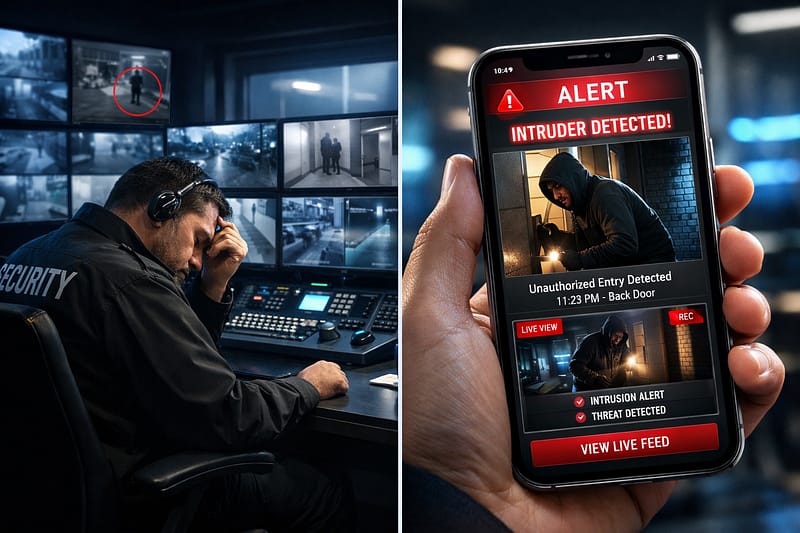
Traditional CCTV answers the question: what happened? AI-powered surveillance answers the more important question: what is happening right now, and who needs to know? The difference is measured in seconds — and sometimes in the difference between prevention and loss.
Typical processing time: < 15 seconds from event to phone
In security, latency is liability. A threat detected at 2 AM that reaches the responsible person at 2:15 AM is, operationally, almost the same as a threat that is never detected. The window for effective intervention — whether that is locking a door, calling an on-site guard, or dispatching a response team — is typically measured in single-digit minutes.
This is not conjecture. The peer-reviewed framework described in AI-powered threat detection in surveillance systems: A real-time data processing framework (Cadet et al., Open Access Research Journal of Engineering and Technology, 2024) is explicit on this point: “Even a few seconds of delay can be detrimental, as it may allow threats to escalate or go unaddressed.” The same paper identifies low-latency processing, automated alert delivery, and edge computing as the three most critical architectural requirements for any real-world AI surveillance deployment.
McKinsey’s 2024 Cyber Market Survey found organizations spent approximately $200 billion on security products in 2024, driven primarily by the need for faster detection and automated incident response. The most-cited capability gap: response automation — the ability to move from detection to alert without human review delay.
Traditional surveillance fails at the alert layer, not the recording layer. The recording works fine. The problem is everything that happens between an event and a decision.
Event detection
Manual — requires someone watching
Automatic — AI detects in real time
Alert speed
Minutes to hours (or never)
Seconds from event to notification
Alert content
None — requires manual review
Snapshot + video clip + event context
Night / off-hours coverage
Depends on staff availability
24/7 autonomous monitoring
False alert management
No filtering — everything triggers
AI context filters out irrelevant motion
Escalation chain
Manual calls / walkie-talkie
Automated — app + WhatsApp in parallel
Accountability trail
No record of who was notified or when
Full log: detected, sent, acknowledged
The industry reference source FSIE (Fire and Security India Expo) makes the same point from the practitioner side: traditional CCTV is reactive, not proactive — it records incidents but does not prevent them. AI-powered cameras, by contrast, understand what they see and can deliver immediate, context-rich alerts the moment something changes.
IndoAI Product Feature
IndoAI’s alert engine is designed around one principle: the right person must receive actionable evidence before they have time to wonder what happened. Here is the full flow from event to resolution.
IndoAI Alert Flow — Event to Resolution
The entire flow from detection to the alert appearing on a phone takes under 15 seconds in typical deployment conditions. This is the operational reality that changes how security works at a plant or facility — not because the cameras are better, but because the alert layer is finally doing its job.
Because IndoAI’s AI models run on-device — on the camera or EdgeBox — detection and local recording continue even when internet connectivity is disrupted. Alerts queue and deliver once connectivity is restored. This matters in factories and warehouses where network reliability is inconsistent.
At a manufacturing plant in Pune, an intrusion alert reached the security head within 8 seconds of detection at 2 AM. He verified the clip on his phone, called the on-site guard, and the situation was resolved before any damage occurred.
What made this work was not the camera resolution — it was the fact that the alert contained enough context (a clear video clip, the camera zone, and the event type) for a confident decision to be made on a phone screen in under a minute. The guard was at the right location within three minutes of the detection. Without the AI alert, the intrusion would have appeared in the morning footage review — hours too late.
📍 Manufacturing Plant · Pune, Maharashtra
It is worth being precise about what separates an alert system that works from one that creates noise. The academic literature and practitioner experience converge on the same list.
If detection requires a round-trip to a cloud server, latency is non-negotiable — you are adding 2–8 seconds before the alert pipeline even starts. IndoAI’s AI models run on the camera’s own processor or on the IndoAI EdgeBox, so detection happens at the point of capture. This is the same principle described in the Cadet et al. (2024) framework as “edge computing to reduce network bottlenecks and enable faster decision-making closer to the data source.”
An alert that says “Motion detected at Camera 7” is operationally almost useless. The recipient has to log in, navigate to Camera 7, find the event, and review footage — a process that takes minutes they typically don’t have. An alert that delivers a snapshot, a clip, a location, and an event type allows a confident decision in under 30 seconds.
Sending only to an app means the alert fails if the app is closed or the phone is on silent. Sending to WhatsApp in parallel is not just a convenience feature — it is a reliability layer. The two most reliable notification channels on an Indian smartphone are voice calls and WhatsApp. IndoAI uses both.
Organisations with multiple shifts, multiple sites, or lean security teams need escalation logic built into the alert system. If the primary recipient does not acknowledge within a set window, the alert automatically moves to the next person in the chain. This prevents the single point of failure that defeats most manual protocols at 3 AM.
Alert fatigue is real. When a system generates too many false positives, recipients learn to ignore or dismiss notifications reflexively — including the real ones. IndoAI’s AI models distinguish between routine movement (a cleaning crew, a stray animal, a flag moving in wind) and genuine trigger events by analysing object class, behaviour pattern, and context. This keeps alert volume at a level where every notification is taken seriously.
Research cited in recent physical security AI literature confirms that operators miss up to 90% of on-screen activity after just 20 minutes of passive monitoring. AI-to-human alert systems do not ask humans to watch — they ask humans to decide, which is what humans are actually good at.
Response speed is universally valuable, but some environments see disproportionate benefit from the shift to AI-driven alerts.
Manufacturing plants and warehouses often have large perimeters, skeleton crews at night, and high-value inventory or equipment. An intrusion alert that arrives in 10 seconds instead of 10 minutes is the difference between a prevented incident and an insurance claim. Worker safety events — PPE violations, falls, unauthorized zone access — benefit equally from fast notification to supervisors.
IT parks and commercial campuses manage dozens of entry points, parking areas, and server rooms across multi-building complexes. Centralised security teams cannot physically watch everything. AI alerts allow a single security manager to maintain effective situational awareness across an entire campus from a phone.
Logistics and cold-chain facilities have compliance-critical zones where access must be logged and controlled in real time. An AI alert for unauthorized access to a controlled area protects both the physical asset and the compliance record simultaneously.
Government and public-sector facilities increasingly require documented audit trails of detection, notification, and response. IndoAI’s alert log — with precise timestamps for every stage — satisfies this requirement out of the box.
Straight answers to the questions we hear most from security managers and facility heads evaluating IndoAI.
In typical deployment conditions, the full alert — snapshot, video clip, and event context — reaches the designated recipient within 8 to 15 seconds of the detection event. Detection itself happens on-device (on the camera or IndoAI EdgeBox), which eliminates cloud round-trip latency from the detection step. The primary variable is mobile network speed at the delivery end. In 4G/LTE conditions, alert delivery is consistently under 10 seconds.
Each alert contains: a high-resolution snapshot from the moment of detection, a short video clip (typically 10–30 seconds) bracketing the event, the camera name and location zone, the event type (intrusion, fire/smoke, PPE violation, crowd, etc.), and the exact timestamp of detection. The alert is delivered simultaneously via the IndoAI mobile app and WhatsApp , so the recipient receives it regardless of which channel they are most responsive to. Action buttons in the alert allow the recipient to acknowledge, escalate, or resolve directly — without needing to open a separate VMS.
Alert recipients are fully configurable. You can assign different cameras or event types to different individuals or groups — for example, fire alerts go to the safety officer, intrusion alerts go to the security head, and PPE violations go to the shift supervisor. Escalation logic ensures that if the primary recipient does not acknowledge within a defined window, the alert automatically routes to the secondary contact. This is particularly important for night shifts and lean security teams where a single point of failure in the notification chain is unacceptable.
Yes — with an important distinction. Detection and local recording continue uninterrupted even without internet, because IndoAI’s AI models run entirely on the edge device (camera or EdgeBox). No cloud connectivity is required for the AI to detect an event and record it locally. Alert delivery to the mobile app or WhatsApp does require an internet connection at the device end. When connectivity is disrupted, alerts queue locally and are dispatched as soon as the connection is restored. For facilities with critical connectivity requirements, IndoAI can be paired with a 4G/LTE backup SIM on the EdgeBox to ensure delivery continuity.
Book a 30-minute demo and see exactly how fast an alert reaches a phone — from the moment of a test event. We demonstrate on your use case: intrusion, fire, PPE, or custom trigger.
