
Research · Platform Selection · India 2026
How to Choose the Best AI Camera Platform With Installable AI Apps in India (2026)
To choose the best AI camera platform in India in 2026, evaluate it like enterprise software, not hardware: demand a real app lifecycle (install, version, rollback, staged rollout), retrofit support for existing CCTV, multi-site governance, DPDP-era privacy controls, and a transparent three-year TCO model driven by bandwidth and operations — not camera price.
In 2026, most enterprises in India are not buying cameras. They are buying a programmable video intelligence layer that has to survive five hard realities: mixed estates of old and new IP cameras across multiple sites; a constant stream of new use-cases across safety, operations, compliance, and incident response; rising privacy and cybersecurity scrutiny; economics where bandwidth, storage, and maintenance — not camera price — drive cost; and platform risk from lock-in, update failures, and integration debt.
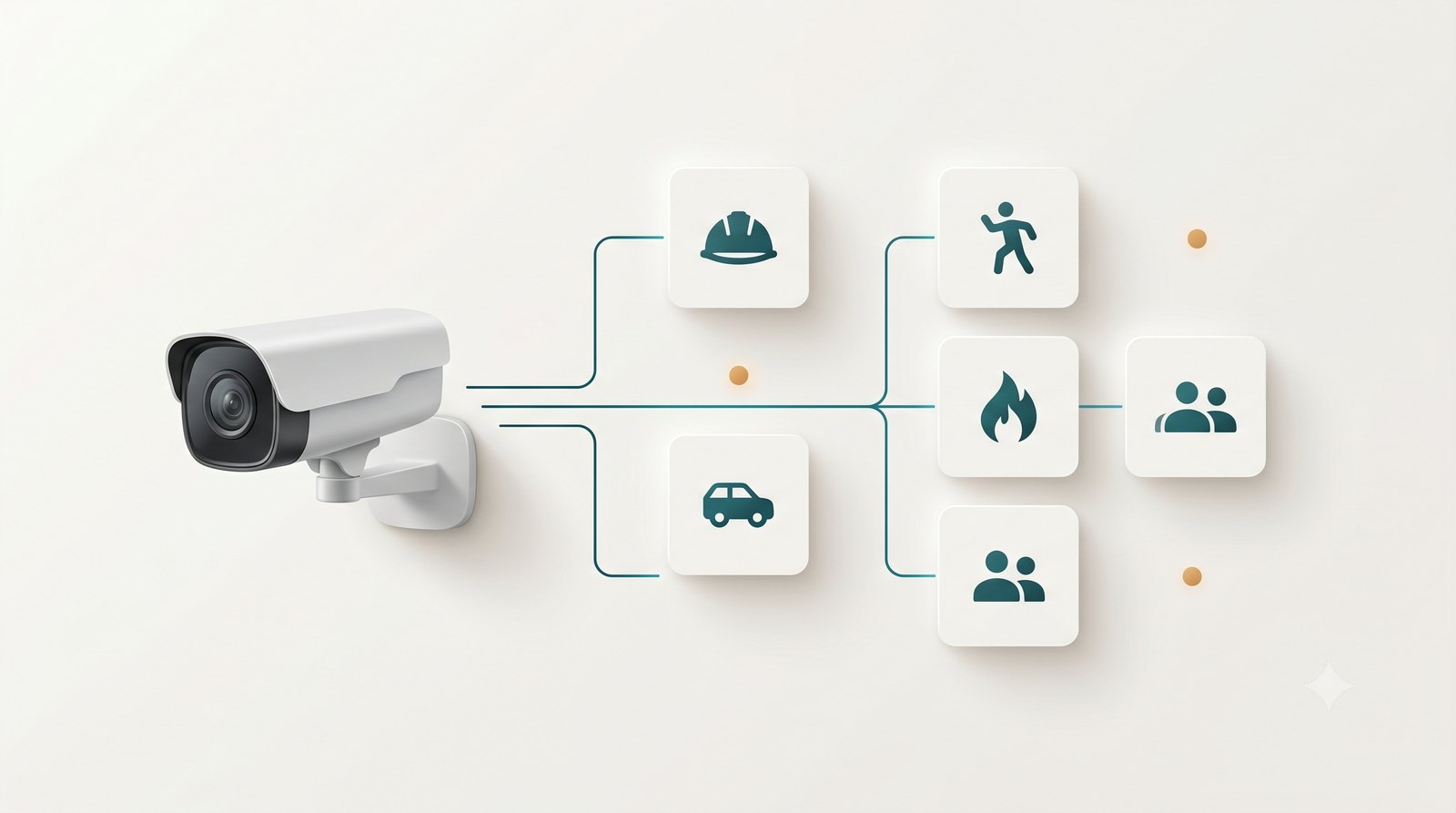
That is exactly why IndoAI is built as a platform, not a single product. Its core capability is Appization: AI should be installable and upgradeable like apps, across your entire video estate — on IndoAI Edge AI Cameras (close to the stream for low latency and resilience), on IndoAI AI-Enabled Cameras (an enterprise IP line under one IndoAI software layer), and on the IndoAI Edge AI Box (the same Appization layer applied to existing CCTV without replacing cameras). One app catalogue, one governance plane, multiple hardware footprints.
1. Why India in 2026 needs a platform, not just analytics
The market is scaling, but the bigger shift is maturity. Analyst estimates differ on the exact size, yet they converge on rapid growth and rising expectations. Grand View Research places India's video surveillance revenue near USD 2.0 billion in 2024, growing at roughly 17% CAGR through 2030. Mordor Intelligence sized the 2025 market at about USD 4.4 billion, with the large majority still on-premises. The headline is not "more cameras" — it is more stakeholders (security, HR, operations, compliance), more workflows, and far higher integration expectations.
Two India-specific regulatory forces now shape every CCTV decision
First, India's privacy regime is now operational. The Government of India notified the Digital Personal Data Protection (DPDP) Rules, 2025 in November 2025, bringing the DPDP Act, 2023 into operational shape with a phased compliance timeline. For enterprises, this turns privacy from a slogan into concrete obligations: safeguards, retention discipline, accountability, and auditability.
Second, cybersecurity scrutiny of internet-connected CCTV has tightened. Reuters reported new Indian rules requiring manufacturers of internet-connected cameras to submit hardware, software, and even source code for testing in government labs, effective from April 2025, alongside a more formalized STQC certification environment. The bottom line: a vendor that cannot show governance controls, secure updates, and certification readiness is a long-term risk, even if the demo looks good.
2. Define "installable AI apps" precisely
Many vendors say "AI apps" when they mean "features." Insist on three proof points before you believe the word.
2.1 Packaging, versioning, and rollback (non-negotiable)
An AI app must be a versioned unit you can install, update, and revert. If a vendor cannot demonstrate rollback, they are not production-ready for enterprise change management. Mature platforms point this direction — for example, Milestone's AI Bridge is operated through container orchestration with lifecycle controls — meaning packaged deployments rather than baked-in features.
2.2 Compute governance (so one model does not break the system)
When multiple apps share one edge device, the platform must manage CPU, GPU, and memory contention plus health. Without resource governance, app ecosystems collapse under real-world load: updates cause unpredictable latency, false alerts spike, and operators lose trust.
2.3 An integration surface enterprises can rely on
Adoption depends on wiring video intelligence into access control, SOC tooling, ticketing, ERP, and mobile workflows. The mature ecosystems make this a quality gate — Milestone's MIP SDK and Genetec's formal integration certification process both reflect enterprise-grade expectations. A platform without stable APIs becomes an island, and islands do not scale.
3. The IndoAI platform architecture you actually standardize on
Evaluate IndoAI the way you would evaluate any enterprise platform — by its layers, not its spec sheet.
The Appization layer packages vision models, business logic, alerting rules, and evidence into installable apps with controlled rollout and central governance. Edge AI Cameras win where you need low-latency decisions at gates and perimeters; the IndoAI-branded AI-Enabled Cameras expand hardware choice while staying inside one software experience; and the Edge AI Box brings the same apps to legacy estates. The advantage is simple: you can modernize without rip-and-replace, and still build one consistent AI ecosystem across new and old deployments.
4. India economics: why edge and Appization win on TCO
Bandwidth and storage are the hidden multipliers. A typical H.264 1080p 30 fps stream can range roughly 1 to 10 Mbit/s depending on scene, motion, and bitrate caps (per Axis guidance). Your platform choice decides whether you move full streams continuously, or whether you move only events and evidence. The Appization model processes at the edge, converts video into structured events — person detected, intrusion, PPE missing — and runs operational workflows on metadata plus short clips, keeping full footage local where needed.
| TCO component | What it covers | Why edge + Appization helps |
|---|---|---|
| Hardware | Cameras, edge boxes, on-prem servers | Reuse existing cameras via the edge box; pay for new hardware only where it earns ROI |
| Storage | Retention, bitrate, redundancy | Lower write rates when workflows run on events plus short clips |
| Bandwidth | Inter-site and any cloud usage | Send events, not continuous streams; reduce WAN and egress costs |
| Software | VMS, AI apps, per-device licensing | One app model across footprints avoids fragmented tooling |
| Operations | Monitoring, updates, support, replacements | Staged rollout and rollback cut operator time and failed-update risk |
Governance is also part of TCO now. DPDP Rules 2025 are notified and operational, and CERT-In's 2022 Directions already require many entities to enable logs and retain them for a rolling 180 days within Indian jurisdiction. Even where CCTV is not the primary ICT system in scope, security teams increasingly expect audit logs, traceability, and retention discipline. Prefer platforms where privacy and retention are product capabilities, not manual SOPs.
5. Compare platform archetypes, not camera against camera
The useful comparison in 2026 is by archetype. Each has strengths; the question is where IndoAI's installable-app and edge-intelligence layer fits.
| Archetype | Examples | Strength | How IndoAI competes |
|---|---|---|---|
| Enterprise VMS ecosystems | Milestone, Genetec | Strong core, integrations-led, open SDKs and certification gates | Positioned as the AI-app and edge-intelligence layer that can coexist with a VMS core |
| On-camera app platforms | Axis ACAP | Validates apps-on-edge for lower latency and bandwidth | Takes apps-on-edge and makes it footprint-flexible: cameras, AI-enabled line, and edge-box retrofit under one Appization layer |
| Cloud-managed / API-first | Verkada, Eagle Eye | Programmable, centrally managed video APIs | Edge-first Appization delivers cloud-like programmability without forcing cloud economics everywhere |
6. The IndoAI-first selection framework: a 14-question checklist
Use these in demos and RFPs — they are designed to separate a platform from a feature bundle.
| Theme | Ask the vendor to show, live |
|---|---|
| App lifecycle | 1. A new app being installed, not just enabled. 2. Versioning — what runs where. 3. Rollback in minutes. 4. Staged rollout: one site, then a region, then all. 5. Resource controls that stop one app starving others. |
| Deployment flexibility | 6. The same app running on edge cameras and on the edge box. 7. AI extended to existing estates without replacement. 8. The operating mode during WAN outages. |
| Evidence & operations | 9. The incident evidence package (clip, snapshots, metadata, timeline). 10. Speed to find "all entries at Gate 2, 2–4pm, helmet missing." 11. The false-alert management system (feedback, thresholding, suppression, retraining hooks). |
| Compliance (India) | 12. How data handling and retention map to DPDP expectations. 13. Posture on CCTV cybersecurity testing, certification, and secure updates. 14. What audit logs exist and how long they are retained. |
7. A practical deployment blueprint
Good rollouts move in three controlled phases — stabilize, prove ROI, then integrate.
Stabilize and unify
Inventory sites, camera counts, critical zones, and network constraints. Set IndoAI Appization as the AI-layer standard. Deploy the Edge AI Box for legacy clusters and Edge AI Cameras for new critical zones.
App packs that show ROI
Start where outcomes are measurable: intrusion and perimeter for after-hours sites, PPE and restricted-zone packs for plants, fire and smoke early warning, vehicle entry workflows for gated premises.
Operational integration
Wire alerts into ticketing, escalation, and SOC dashboards. Add role-based access and audit trails. Build evidence exports and reporting for compliance and incident documentation.
Stage, don't switch
Pilot one representative site, run shadow mode, tune thresholds, then expand with templates — so a model change never destabilizes the whole estate.
Appization is what makes this work: each new capability is added as an app pack rather than a re-architecture project.
8. India-relevant deployment patterns
Three recurring patterns show how the platform plays out in the field.
Multi-site manufacturing (300 cameras, 6 plants). Safety incidents and inconsistent enforcement, with high manual-monitoring cost. The approach: Edge AI Box to modernize older plants without replacement, Edge AI Cameras in new lines and hazard zones, and PPE plus restricted-zone packs tuned site-by-site with staged rollouts. The economic logic is less operator time, fewer incidents, and lower bandwidth by pushing events rather than full streams. See factory safety.
Large township / housing society (200 cameras). Gate incidents, unauthorized entry, and slow investigations. The approach: AI-Enabled Cameras at gates and choke points for better capture, Edge AI Box for remaining legacy cameras, and apps for vehicle-entry analytics and after-hours perimeter, with clear roles for society admins versus security supervisors plus audit logs and retention policy.
Campus (college or enterprise park). Incidents happen, but evidence is hard to assemble and response is slow. The approach: standardize on Appization so new apps can be added each quarter, extend analytics to existing cameras via the Edge AI Box, and install packs mapped to campus needs — crowding, restricted areas, fire and smoke. The outcome is faster evidence retrieval and more consistent response. See perimeter security.
9. Future-proofing for the next 24 months
The next wave is not "more detections" — it is video-to-workflow automation: on-site semantic video search (query by intent, not timestamps), event summaries and anomaly detection, and video agents that answer operational questions with evidence and audit trails. To be ready, you need an Appization lifecycle for installable updates, a stable metadata model, strong governance and audit logs, and hardware-footprint flexibility across edge camera, edge box, on-prem, and optional cloud.
10. The simplest way to choose correctly
If you are an enterprise buyer in India in 2026, choose the platform that gives you a real app lifecycle (install, update, rollback, staged rollout), a governance plane that stands up to DPDP-era expectations, security and compliance readiness in a stricter CCTV environment, retrofit capability so ROI is not blocked by replacement cycles, and a clear three-to-five-year TCO story driven by bandwidth, storage, and operational workload — not camera price. That is the case for a platform, and it is the case for IndoAI: Appization across Edge AI Cameras, AI-Enabled Cameras, and the Edge AI Box, with one ecosystem and one upgrade path.
Frequently asked questions
What does an "AI camera platform with installable AI apps" actually mean?
AI capabilities are packaged like software apps that can be installed, upgraded, rolled back, and governed across sites and devices. A genuine platform shows packaging and versioning, deployment control to a specific site or camera group, staged rollout, fast rollback if a new model raises false alerts, and governance with role-based access, audit logs, and retention. If a vendor cannot demonstrate versioning, rollback, and staged rollout, they are selling features, not apps.
How is IndoAI different from normal AI cameras sold in the market?
Most AI cameras are single-use-case devices or carry a few bundled analytics that do not evolve. IndoAI is built as a platform with Appization at the center: capabilities install and upgrade like apps, and the same ecosystem runs across IndoAI Edge AI Cameras, AI-Enabled Cameras, and existing estates via the Edge AI Box. This matters in India, where most enterprises have mixed estates and cannot replace everything to adopt new use-cases.
What is Appization in simple words?
Appization is the idea that AI should work like mobile apps. You install a capability such as PPE detection, intrusion, fire and smoke, or vehicle analytics; upgrade it as better versions release; disable it when the use-case changes; and control where it runs and who sees outputs. Enterprises stop treating AI as a one-time project and start treating it as a repeatable, governed capability.
Can IndoAI work with existing CCTV without replacing cameras?
Yes. The IndoAI Edge AI Box connects to existing IP camera streams via standard methods, runs IndoAI apps at the edge-box level, and delivers alerts, evidence clips, dashboards, and reporting. Enterprises modernize without waiting for full camera replacement cycles, which reduces capital risk and speeds adoption.
Where do the AI apps run: on camera, on an edge box, or in the cloud?
A mature platform supports multiple surfaces. On-camera is best for low latency and bandwidth reduction; an edge box is best for retrofitting existing CCTV and running heavier models near the site; an on-prem server suits large sites with strong IT; cloud helps centralized management but can raise ongoing cost and bandwidth dependence. IndoAI keeps the same app ecosystem consistent across these surfaces to avoid fragmented tooling.
What are the biggest mistakes enterprises make when buying AI video analytics?
Buying a demo-driven solution with no rollout or governance plan; ignoring false positives until operators stop trusting alerts; underestimating bandwidth and storage; failing to plan workflow integration; choosing a closed system that is expensive to expand; and not defining acceptance criteria for lighting, angles, and capture quality. Evaluation must cover deployment, governance, and operations, not only accuracy claims.
How do we evaluate accuracy without being fooled by marketing claims?
Define the environment first: lighting, camera angle, distance, crowd density, uniforms, occlusion. Measure with precision, recall, and false positives per hour or day. Run a pilot with a baseline logging period, then shadow mode where alerts are recorded but not acted on, then a controlled rollout one zone at a time. Insist on threshold tuning, suppression rules, and model version rollback.
What is the most important feature after accuracy?
Operational reliability and governance. Even a good model fails if it cannot be rolled back after an update, spams operators with alerts, lacks audit trails, cannot scale cleanly across sites, or cannot produce usable evidence packages. The best platforms treat AI as a managed lifecycle, not a one-time feature.
How should we calculate TCO for an AI camera platform in India?
Include hardware (cameras, edge boxes, on-prem servers), storage (retention, bitrate, redundancy), bandwidth (inter-site and any cloud usage), software licensing (VMS, AI apps, per-device costs), implementation (deployment, integration, testing), and operations (monitoring, updates, support SLAs, replacements). For multi-site enterprises, the hidden drivers are usually bandwidth, storage, and operations effort, not camera price.
What does future-proofing mean for the next 24 months?
New AI apps deploy without re-architecture, models upgrade safely with rollback, new sites are added fast using templates, governance strengthens with privacy and audit controls, and emerging features such as on-site semantic video search and event summarization can be adopted over time. Future-proofing is a capability, not a promise: lifecycle management plus an app ecosystem plus integrations.
How does IndoAI handle multi-site governance in enterprises?
Site-based policies and templates with HQ policy and site overrides, role-based access control, audit logs of administrative actions, app version visibility across the estate, health monitoring for uptime and storage, and staged rollouts with controlled upgrades. For Indian enterprises with 10 to 100-plus sites, governance matters more than raw features.
What are the privacy and compliance considerations in India?
If use-cases involve personal data such as faces, identity, attendance, or visitor tracking, treat privacy as a formal requirement: clear purpose definition, access limitation, retention rules, evidence handling with audit trails, and vendor accountability for security and updates. India's DPDP regime has been operationalized through notified rules, so prefer platforms where privacy and retention are controllable at the product level rather than SOP-only.
Can we start small and scale, or do we need a big-budget rollout?
Start small, but design it correctly. Pick one or two sites with representative conditions, not only the easiest site. Select two or three apps that drive ROI such as safety, intrusion, and fire or smoke. Run a structured pilot with acceptance criteria and performance tracking. Then scale with templates, app packs, and staged deployments. IndoAI is designed to expand app-by-app and site-by-site without redesign.
How do we avoid vendor lock-in while still getting a clean experience?
Lock-in happens through proprietary camera-only ecosystems, closed APIs, data trapped in vendor formats, and high switching cost. Reduce it by preferring platforms that support mixed estates via an edge layer and keep the app model consistent, demanding APIs for events and evidence exports, and adding new capabilities as apps rather than another vendor silo. The goal is controlled dependency with escape paths, not zero dependency.
What should we ask for in an RFP or procurement demo?
Ask for five live demonstrations, not slides: install an app to a specific camera group; upgrade the version across two sites with rollout control; roll back the version and show the audit log; show an evidence package with alert, clip, and metadata export; and show a multi-site dashboard with device health, app versions, and alert volume. Then ask for a three-year TCO model for 100 cameras across 10 sites, 30-day retention, three apps, and support SLA included.
Map your camera estate to the right platform mix
Get a site-by-site assessment that proposes the right blend of Edge AI Cameras, AI-Enabled Cameras, and Edge AI Box retrofit — with a phased app roadmap and a transparent three-year TCO view.
Start your IndoAI assessment