
Comparison · Edge vs Cloud · India
IndoAI vs Rhombus (India, 2026): edge collaborator, or full-stack cloud?
IndoAI vs Rhombus comes down to two philosophies. Rhombus is a full-stack, cloud-managed platform built around its own cameras and per-camera annual licences. IndoAI is an open edge-AI layer that adds installable AI models to cameras you already own. For India's largely analog, cost-sensitive, DPDP-bound estates, IndoAI's collaborator model usually fits first.
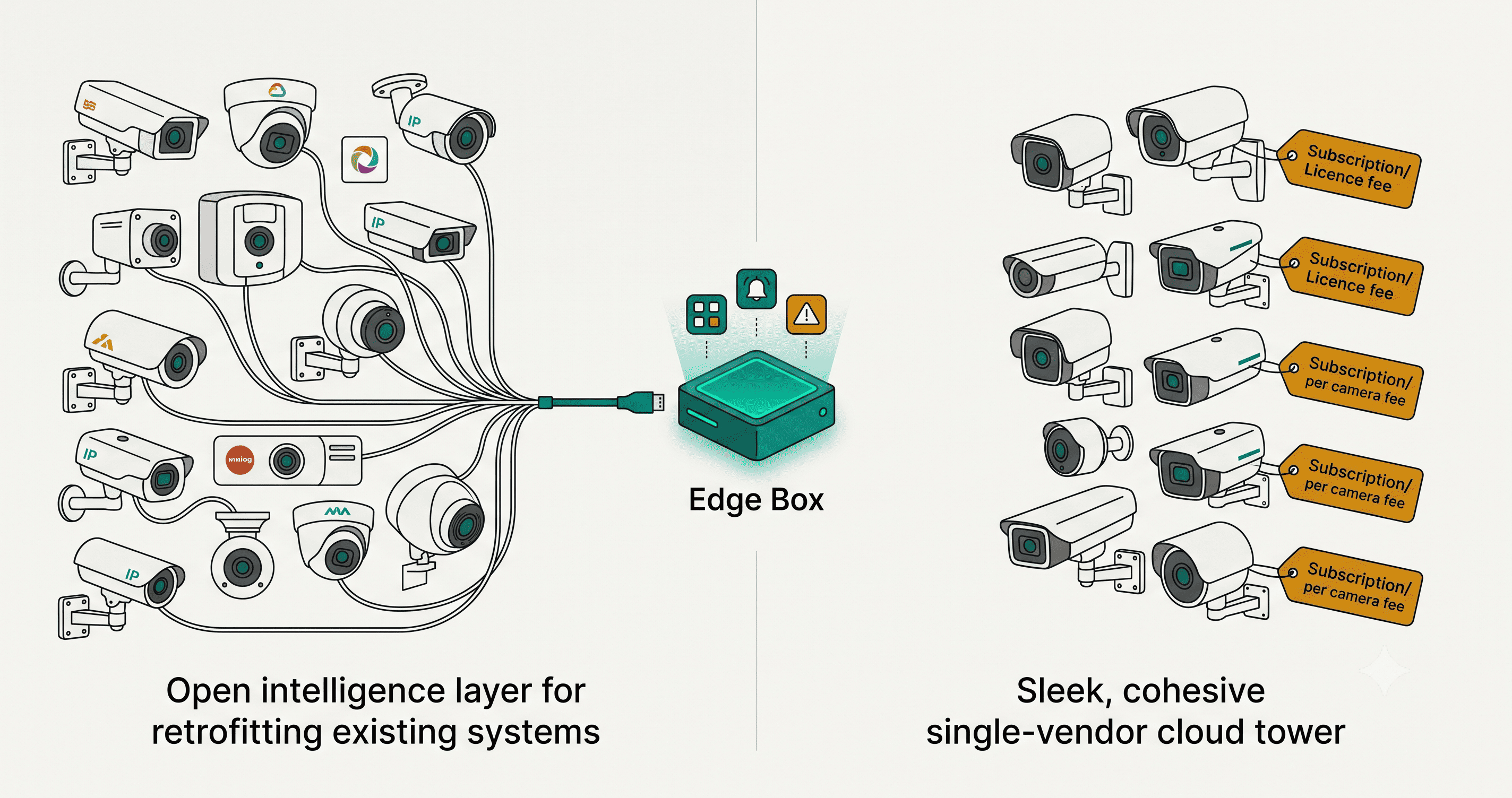
The old framing was "competitor." The honest framing is "collaborator."
Earlier versions of this comparison treated the choice as a fight: our cameras against theirs, edge against cloud, winner takes the site. That framing has aged badly — and not only because it was combative. It was becoming technically inaccurate. Modern cloud platforms, Rhombus included, now store video on-camera and run analytics at the edge too. Pretending otherwise would cost credibility with the exact integrators and CISOs this article is written for.
So here is the evolved position. IndoAI does not see itself as a rival to the hardware ecosystem — camera OEMs, NVR vendors, or platforms. IndoAI is a collaborator: an intelligence layer that makes the cameras a site already owns smarter, whatever the brand. That reframing is not a marketing softening. It is the more accurate description of how video intelligence actually gets deployed across India, where most cameras are already on the wall.
What each one actually is
IndoAI
- Edge-first AI layer. A 16-channel on-premise Edge Box runs AI models locally, so video is processed on-site with lower latency and no per-frame cloud cost.
- Appization. Install, switch and upgrade AI models like apps — 65+ models, multiple per camera or zone.
- Retrofit-first. Adds AI to existing IP cameras in place, or analog/DVR estates through an encoder. Greenfield IndoAI cameras are also available.
- Sold as an itemised system (cameras/Edge Box, storage, accessories, models) with a rupee-priced BOQ — not a blanket licence.
Rhombus
- Cloud-managed physical-security platform built around its own cameras, sensors, access control and a unified console.
- On-camera storage plus edge analytics; cameras come online over PoE with no NVR/DVR, automatic firmware updates and a 10-year hardware warranty.
- AI features (facial and licence-plate recognition, people counting) are tied to the higher Enterprise licence tier.
- Third-party cameras can be bridged in via the N100 relay, but each still needs a per-camera licence to use AI.
Read plainly: Rhombus is excellent when you want one vendor to own the whole estate and you are comfortable buying its cameras and paying per camera, per year. IndoAI is built for the opposite starting point — a site that already has cameras and wants to add intelligence without a forklift replacement. Neither is "better" in the abstract; they answer different questions.
Why India changes the IndoAI vs Rhombus comparison
The decision looks different in India than in a fibre-rich, greenfield US corporate campus. Three structural facts move the needle.
1) The installed base is mostly analog
India's video-surveillance market is large and growing fast — roughly USD 4.4 billion in 2025, heading toward USD 7.1 billion by 2030 at about a 10% CAGR, with hardware still the dominant spend. But the more decision-relevant number is this: an estimated ~80% of India's installed CCTV is still analog or non-IP. A model that requires you to rip out working cameras and buy new IP hardware plus annual licences is fighting that installed base. A model that adds AI to what is already on the wall is working with it. This is the single biggest reason the collaborator posture fits India first.
2) CFO math and subscription scrutiny
Indian buyers open with a blunt question: what is my 3-year and 5-year total cost of ownership? Recurring, per-camera licences get scrutinised hard at scale. Using Rhombus's own November 2025 price sheet, a camera needs an ongoing licence on top of the hardware: the Professional tier is about USD 149 per camera per year and Enterprise — the tier that unlocks AI — about USD 199 per camera per year (multi-year terms discount this). Across 50 cameras on Enterprise, that recurring line alone is roughly USD 10,000 every year, before hardware, storage add-ons or installation.
IndoAI is structured differently. There is no mandatory per-camera annual cloud licence; you buy the Edge Box (or IndoAI cameras), the storage and accessories you need, and the AI models the site actually uses. Indicative pre-built kits run from about ₹7,08,000 for a Housing Society Entry & ANPR kit to about ₹10,86,000 for a Factory Safety & PPE kit — cameras, Edge Box, storage, mounts, cabling, UPS and PoE included — and the count is often reduced after a site survey. The recurring burn is lower and more predictable, which is exactly what a CFO wants to model.
TCO is not only about licences. A pixel-per-metre (PPM) figure tells you what a camera can actually resolve. Face identification needs roughly 80 PPM and ANPR even more. Under-spec the placement and accuracy collapses in low light — no AI model recovers pixels that were never captured. The fix is a three-step survey: map coverage and blind spots, check PPM at each face/ANPR zone, then size the edge compute. IndoAI runs exactly this survey before quoting, which is why retrofit counts often shrink.
3) DPDP is now live, not theoretical
The Digital Personal Data Protection (DPDP) Rules, 2025 were notified in November 2025, operationalising the DPDP Act with an 18-month phased runway. They emphasise purpose-linked notices and consent, breach notification, minimum security safeguards, a one-year log-retention floor, and localisation for notified data categories. Video that identifies people is squarely in scope. Edge processing does not make anyone automatically compliant — but by keeping raw video on-premise and moving only events and metadata off-site, it makes data minimisation and reduced external transfers far easier to implement. That is a practical advantage in India's direction of travel.
How the intelligence actually reaches the camera
The clearest way to see the difference is to trace the video path. In the IndoAI model, existing cameras feed the on-site Edge Box; inference happens on-premise; only structured events leave the building.
Raw footage stays on-site. Only structured events cross the network — lower bandwidth, lower latency, easier DPDP data minimisation.
The Rhombus path is coherent but different in shape: Rhombus cameras → on-camera storage & edge analytics → Rhombus cloud console, with AI features gated behind the Enterprise per-camera licence. It is a clean, single-vendor pipeline — powerful if you are buying the whole pipeline. IndoAI instead decouples the intelligence from the hardware, so the AI is not locked to a specific camera you must purchase and re-licence every year.
Side-by-side: architecture and operations
| Dimension | IndoAI | Rhombus | India-reality read |
|---|---|---|---|
| Core posture | Open intelligence layer; collaborates with existing hardware | Full-stack, single-vendor cloud platform | IndoAI fits retrofit-heavy estates |
| Where AI runs | On-premise Edge Box, by default | On-camera + cloud console; AI in Enterprise tier | Both edge-capable; IndoAI needs no camera swap |
| Model flexibility | Appization: 65+ installable models, multiple per camera | Fixed feature set per licence tier | IndoAI for evolving, multi-model needs |
| Existing CCTV | IP in place; analog/DVR via encoder | Third-party via N100 relay + per-camera licence | IndoAI native to India's analog base |
| Recurring cost | No mandatory per-camera annual licence | ~USD 149–199 / camera / year | IndoAI easier on multi-year TCO |
| Connectivity resilience | Detection continues offline (edge) | Some cloud workflows sensitive to network | IndoAI for weak-link sites |
| Central management | One app: feeds, alerts, clips, model control | Mature unified console + access control + sensors | Rhombus strong for single-vendor ops |
| DPDP alignment | Raw video stays on-site; events leave | Cloud-managed; localisation depends on config | IndoAI simplifies data minimisation |
| Pricing basis | Itemised BOQ in ₹, models as needed | Hardware + per-camera licence in USD | IndoAI native to India procurement |
The 3-year TCO picture
Model TCO per site with a simple frame. A Rhombus-style deployment stacks: imported camera hardware (plus duties, spares, warranty), the per-camera licence per year, any bandwidth upgrades, optional cloud archiving, and India support logistics such as RMA cycles across time zones. An IndoAI-style deployment stacks: the Edge Box or IndoAI cameras (or a retrofit path onto existing CCTV), only the AI models you need, lower bandwidth from edge processing, and capability growth by installing new models instead of replacing cameras.
For a 50-camera site kept on Enterprise, the licence line alone is on the order of USD 10,000 per year — meaningful money over three to five years, and recurring regardless of how much AI you use per camera. IndoAI's collaborator model typically wins on three axes in India: lower recurring burn, better performance on uneven networks, and easier phased rollouts — start with a few zones, add models later, no re-licensing per device.
Where Rhombus is genuinely the right call
This is not a one-sided piece. Rhombus is a well-built, well-liked platform, and there are profiles where it is the smarter buy:
- You are deploying greenfield and happy to standardise on one vendor's cameras, sensors, access control and alarms under a single console.
- Your sites have consistently strong internet and a mature IT team that values automatic firmware updates and a hands-off, cloud-managed experience.
- You prioritise centralised administration and a polished unified UI above edge autonomy and per-model flexibility.
- You want a long hardware warranty and an established partner network, and USD-denominated subscription economics are not a procurement obstacle.
For that buyer, Rhombus feels smooth and complete. The honest read is that it competes on being an integrated system — and IndoAI competes on being an open layer that respects the cameras and budgets you already have.
The question in India is rarely "whose camera is best." It is "how do I add intelligence to the cameras already on the wall, without a licence meter on every one of them."
The India-first read
Across most Indian deployments — retail, factories, schools and colleges, hospitals, housing societies, multi-site operations — IndoAI tends to fit first because it is architected for India's operating reality: an edge-first design for weak connectivity, Appization for continuous capability upgrades without forklift replacements, a retrofit-ready path for the enormous analog installed base, and a posture that aligns with where privacy governance is heading under DPDP. Rhombus remains a strong choice for the greenfield, single-vendor, cloud-first buyer with reliable internet.
The most useful way to end is not with a scoreboard but with a starting point: figure out what you already own, what you actually need to detect, and what your three-year TCO looks like on each path. If you are retrofit-heavy and rupee-sensitive, the collaborator model is usually where to begin. To go deeper on the retrofit approach, see how Appization lets you install AI models like apps, and the IndoAI FAQs on connecting to existing CCTV.
Model both paths for your actual site
Describe your site in plain language and get an itemised system — cameras or retrofit Edge Box, storage, accessories, the AI models you need, ROI and a real BOQ — anchored to IndoAI's live catalogue.
Get my site blueprint →Frequently asked questions
Is IndoAI a competitor to camera and NVR hardware makers?
What is the main difference between IndoAI and Rhombus?
Does Rhombus work with existing third-party cameras?
Which is better for India's mostly-analog CCTV base?
How does Rhombus pricing work?
How does IndoAI pricing work?
Does edge processing help with DPDP compliance?
What AI models does IndoAI run?
Will IndoAI work when internet is unreliable?
When is Rhombus the better choice?
Can IndoAI do natural-language video search?
Vivek leads the science behind IndoAI's edge-first AI camera platform, focusing on on-device inference, retrofit deployment for India's existing CCTV base, and DPDP-aware video intelligence. He writes on where edge AI, privacy and real-world security operations meet.