
Decision Guide · Edge AI · India
IndoAI vs Verkada in India: why the smartest 2026 choice is a layer, not a rival
IndoAI vs Verkada is not an either-or contest. Verkada is a full-stack, cloud-managed camera platform; IndoAI is a programmable edge AI layer that adds analytics to cameras you already own or newly buy. In India, most buyers now pair STQC-compliant hardware with IndoAI's on-device intelligence, keeping video local and DPDP-aware.
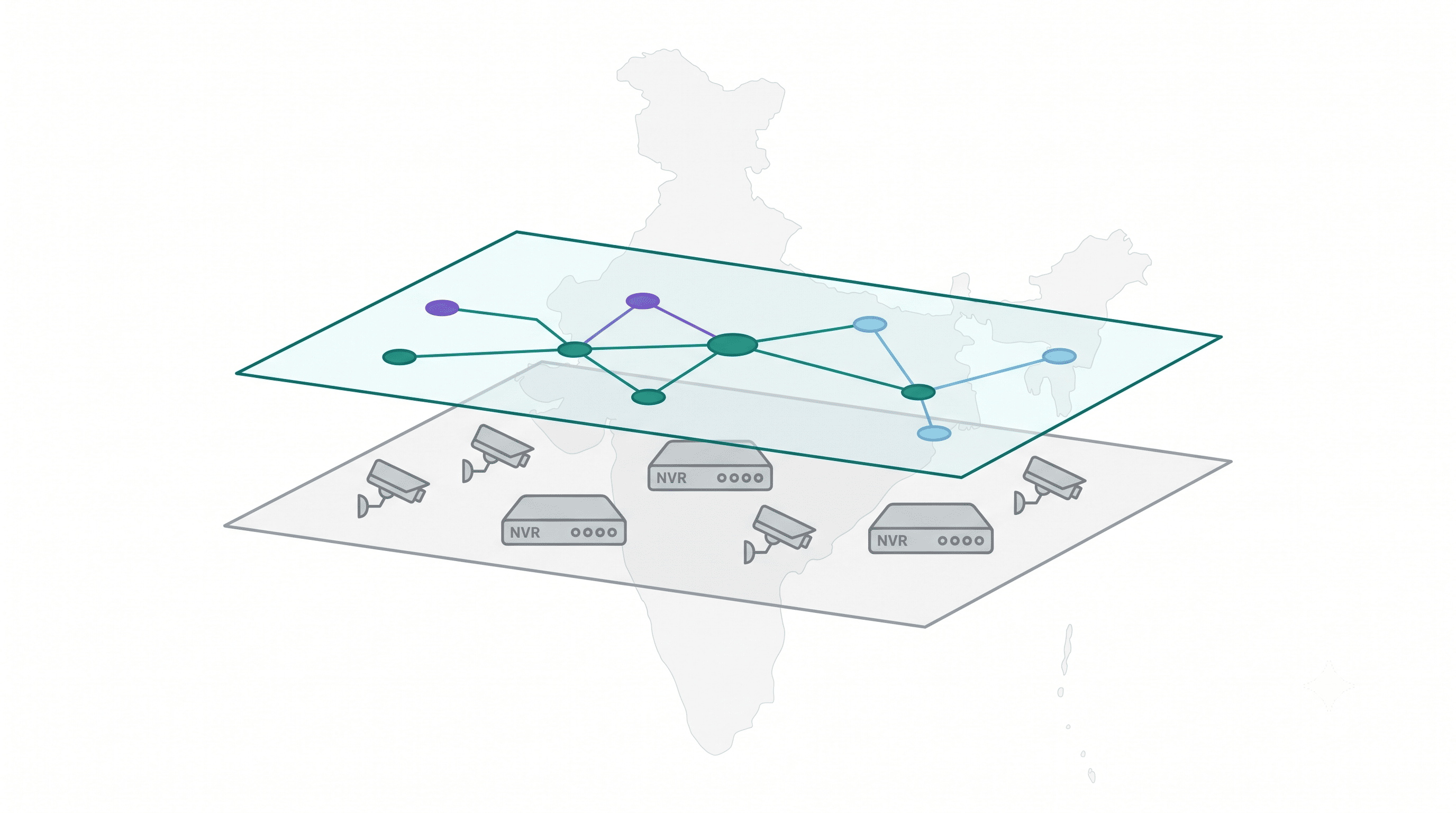
Three years ago, comparing a video-security platform in India meant comparing boxes: this camera versus that camera, this cloud versus that cloud. That framing is now out of date. India's regulatory floor for hardware has risen sharply, the privacy regime has teeth, and the highest-value part of any deployment — the analytics — has separated from the metal it runs on. So the honest 2026 answer to "IndoAI vs Verkada" begins by splitting the question in two.
The two questions buyers keep confusing
When someone types "IndoAI vs Verkada" into a search bar, they are usually asking two very different things at once, and conflating them leads to bad procurement.
Question 1 — The hardware stack
What cameras and recorders do I standardise on?
Form factor, resolution, warranty, cybersecurity certification, and how footage is stored. In India this is now heavily governed by regulation.
Question 2 — The intelligence
What outcomes do I want the video to produce?
Safety alerts, ANPR, shrinkage detection, occupancy, natural-language search. This is where value lives — and it no longer has to come from the same vendor as the camera.
Verkada answers both questions with one integrated stack. That is its strength and its trade-off. IndoAI deliberately answers the second question and stays open on the first — which is why it is better understood as a programmable AI camera platform that collaborates with the hardware ecosystem rather than a hardware competitor. IndoAI (founded 2021, Pune) adds installable, on-device analytics to new IndoAI cameras, to third-party cameras, and to CCTV estates already bolted to your walls.
What changed in 2025–26: India rewired the hardware conversation
The single biggest shift is regulatory, and it strengthens the collaborator case rather than the combat one.
From 1 April 2026, only CCTV cameras conforming to MeitY's Essential Requirements (ER) — validated through STQC under the IoT System Certification Scheme — can be legally sold in India. The relaxation that previously let non-compliant stock clear has been withdrawn. The mandate applies to internet-connected and IP cameras and covers secure boot, encrypted storage and communication, authentication controls, tamper protection, and limits on unauthorised data transmission out of the country. It builds on the ER regime gazetted in March 2024, made mandatory for government procurement from June 2024, and enforced for IP cameras from 9 April 2025.
Why this matters
If you buy or specify cameras in India, your hardware choice is now constrained by certification, not just brand preference. Compliant, largely India-made hardware — from established domestic manufacturers — is becoming the default at the camera layer. The open question that remains is the intelligence layer on top.
This is precisely where IndoAI's posture pays off. Rather than asking a buyer to abandon a fresh investment in ER-compliant cameras, IndoAI's edge appliance sits behind them and turns compliant metal into an outcome engine. The hardware makers keep the hardware relationship; IndoAI supplies the analytics. That is collaboration, not displacement — and it maps cleanly onto how the Indian market now buys.
Where Verkada is genuinely excellent
A fair comparison credits the incumbent honestly. Verkada is a strong, well-engineered platform, and for the right buyer it is the right answer.
- Unified cloud operations. Its Command platform gives one pane of glass for devices, users, permissions, investigations and alerts across many sites — excellent where connectivity is stable and a single-vendor stack is desired.
- Hybrid-cloud engineering. On-device storage and edge processing, with cameras designed to minimise upload bandwidth (Verkada cites figures in the 20–50 Kbps range) and to keep recording through internet outages.
- Integrated suite. Cameras, access control, intercoms, alarms and sensors, all managed together, with AES-256 encryption at rest in the cloud and long local retention.
- Expanding data residency. Cloud storage regions now span the US, Canada, Ireland, Germany, Australia, Japan, Singapore and South Korea.
If a global enterprise has standardised worldwide on Verkada and already cleared its data-processing approvals, that momentum is real and valuable. The friction shows up specifically at the India edge of that estate.
Where IndoAI fits: the programmable AI layer
IndoAI's design centre is different by intent. It optimises for outcomes on the edge, portability across hardware, and India's operating realities.
Retrofit
AI-enable existing CCTV
An Edge AI Box ingests RTSP from your current NVR or IP cameras and runs analytics on-site — no fleet replacement.
Appization
Installable AI models
Appization is an app-store approach: start with one or two use cases via the AI app marketplace, expand without re-platforming.
Edge-first
Works when the WAN drops
Detection, alerting and recording run locally, suited to Tier-2/3 sites and shared-ISP buildings across India.
DPDP-aware
Video stays on-site
On-device, India-resident processing supports data minimisation and purpose limitation — including on-site semantic video search over local footage.
That last capability deserves a plain-language note: IndoAI supports natural-language video query — asking "red truck at the gate after 8pm" and getting the clip — run against footage held on-site, without shipping raw video to a third-party cloud. It is analytics as a service to your data, not your data as a service to someone else.
Architecture: how the layer actually connects
The collaboration is concrete, not rhetorical. Here is the data path in a typical Indian retrofit, where the existing hardware and the IndoAI layer coexist.
Data path — existing hardware to on-site intelligence
Video and analytics stay on-site by default — the hardware vendor keeps the camera; IndoAI supplies the outcome.
Data residency and DPDP: the detail that stalls procurement
This is where India-specific friction is most concrete, and where the two approaches diverge most.
Verkada's own documentation lists cloud storage regions across the US, Canada, Ireland, Germany, Australia, Japan, Singapore and South Korea, and data-processing locations of US, EU or AU; authentication data is processed in the US during initial configuration. India is not a listed storage or processing region. Verkada can absolutely be operated compliantly, but for an organisation that wants video processed and stored inside India, that gap becomes an internal-approval problem rather than a technical one.
Meanwhile India's own regime has moved from principle to procedure. The DPDP Rules 2025 were notified on 13–14 November 2025, operationalising the Digital Personal Data Protection Act, 2023 on a phased timeline — procedural provisions live now, and substantive obligations due by 14 May 2027. The rules require itemised notice, purpose-limited consent, defined retention, and breach notification within 72 hours, with penalties reaching ₹250 crore for security-safeguard failures. Cross-border transfer follows a blacklist model — permitted except to countries the government notifies as restricted — so the practical issue for cameras today is audit-readiness and internal risk appetite, not an outright ban.
The reframe
DPDP does not force you to pick IndoAI. But an on-device, India-resident architecture shortens the compliance path: less cross-border complexity to document, fewer legal approvals, and a cleaner data-minimisation story. When video never leaves the site by default, a large class of privacy questions simply does not arise. Read our DPDP-compliant video analytics use case for the full workflow.
Total cost of ownership: an India-grounded worked example
Consider a 50-camera multi-site business that already owns a working, soon-to-be-ER-compliant CCTV estate and wants safety and ANPR analytics. The interesting number is not sticker price — it is the shape of the cost over three years.
A cloud-platform path typically means replacing cameras with premium hardware (broadly USD 500–3,500 each) plus a mandatory recurring cloud licence per camera (commonly USD 199–400 per camera per year, lower on multi-year terms). For 50 cameras, the licence line alone is a permanent operating expense that recurs whether or not you add a single new use case. Layer in FX exposure and import duties, and the India math tightens further.
The retrofit-plus-layer path concentrates spend on a shared on-site appliance and the specific analytics you switch on, while the existing cameras keep earning. New capability is an app, not a re-platforming project.
IndoAI vs Verkada: the side-by-side that matters in India
Stripped to essentials, the choice is not a winner and a loser — it is which layer you are optimising for. The table below reads the two against the constraints Indian estates actually face.
| Dimension | Verkada (full-stack cloud) | IndoAI (programmable AI layer) | India fit |
|---|---|---|---|
| Core model | Camera + firmware + cloud, one vendor | Analytics layer over any/existing camera | Depends on goal |
| Existing CCTV | Generally replace with Verkada cameras | Retrofit via Edge AI Box (RTSP ingest) | IndoAI |
| Bandwidth / outage | Hybrid cloud; 20–50 Kbps; records through outages | Edge-first; core analytics run locally | IndoAI |
| Data residency | US/EU/AU processing; India not listed | On-prem / in-India by design | IndoAI |
| Commercial | Premium hardware + per-camera licence | Shared appliance + apps you use | IndoAI |
| Analytics breadth | Strong, tightly integrated built-ins | Installable, India-contextual, expandable | IndoAI |
| Single-vendor ops | Excellent one-pane-of-glass suite | Unified where it matters; hardware stays open | Verkada |
| Best for | Global standardisation on one stack | India estates, mixed brands, phased AI | Fit-dependent |
The collaboration model in practice
Three procurement patterns show how the layer coexists with hardware rather than fighting it.
1. Upgrade an existing estate
The customer has dozens or hundreds of cameras. Ripping them out is a non-starter. The first step is an RTSP feed into an on-site appliance; the second is switching on one or two analytics apps; the third is expanding as ROI is proven. The hardware vendor is untouched.
2. New ER-compliant fleet plus AI layer
A buyer purchasing fresh, STQC-compliant cameras from a domestic manufacturer adds IndoAI as the intelligence tier. Two suppliers, two clean relationships, one outcome — and the buyer avoids single-vendor gravity while staying compliant. See how this plays out in our manufacturing safety pillar.
3. Phased Appization across sites
India buyers like pilots that become rollouts. Because capability is installable, a site can begin with vehicle counting and later add PPE detection and retrofit analytics without redesigning anything. Budget stays outcome-led.
When Verkada is still the right call
To keep the comparison fair: Verkada is the stronger choice if you are a global MNC with established US/EU data-processing approvals, standardising worldwide on a single vendor, comfortable with recurring-licence economics, and prioritising one integrated platform for cameras, access, alarms and intercoms over local customisation. In those conditions, the single pane of glass earns its premium.
A fair 30–45 day pilot framework
Do not decide on brochures. Run the same test on both, on two to three representative sites, and let the numbers speak.
- Incident-to-action time — how fast a real event reaches a human who can act.
- False-alert rate — the number that decides whether operators trust the system.
- Bandwidth impact — measured on your actual, shared uplinks.
- Three-year total cost — hardware, licences, appliances and expansion included.
- Ease of scaling to 20 sites — and compliance sign-off time from legal.
Talk to the platform
Not sure which layer your estate needs?
Get a free, site-specific assessment: what your current cameras can already do with an AI layer on top, where retrofit beats replacement, and how to keep video on-site and DPDP-aware. No fleet rip-out required.
Get your site blueprint →Frequently asked questions
Is IndoAI a competitor to Verkada?
Not directly. Verkada is a full-stack, cloud-managed camera platform that supplies hardware, firmware and cloud together. IndoAI is a programmable edge AI layer that adds analytics on top of cameras — IndoAI's own, or existing and STQC-compliant hardware from other makers. In most Indian deployments IndoAI collaborates with the hardware layer rather than replacing it.
Can IndoAI add AI to my existing (non-IndoAI) cameras?
Yes. An IndoAI Edge AI Box ingests standard RTSP streams from your existing NVR or IP cameras and runs analytics on-site, so you can AI-enable a fleet you already own without ripping it out. This retrofit path is the most common way Indian buyers start with IndoAI.
Does Verkada store or process video data in India?
As of 2026, Verkada's documentation lists cloud storage regions including the US, Canada, Ireland, Germany, Australia, Japan, Singapore and South Korea, and data-processing locations of US, EU or AU. India is not listed as a storage or processing region, and authentication data is processed in the US during setup. For an India-only data-residency requirement this creates approval friction.
What is the April 2026 STQC / ER-01 rule and does it affect me?
From 1 April 2026, only CCTV cameras conforming to MeitY's Essential Requirements (ER) — validated through STQC under the IoT System Certification Scheme — can be legally sold in India. It applies to internet-connected/IP cameras and covers secure boot, encrypted storage and communication, authentication and tamper protection. It shapes which hardware you can buy; IndoAI's AI layer runs on top of compliant cameras.
Does IndoAI work without the internet?
Yes. IndoAI is edge-first: detection, alerting and recording run on the on-site appliance and keep working when the WAN is down. Cloud is used for optional sync and remote management, not as a dependency for core analytics — which suits India's uneven connectivity.
How does IndoAI pricing compare to Verkada's per-camera licenses?
Verkada bundles premium hardware with a mandatory recurring cloud license per camera (commonly around USD 199–400 per camera per year, lower on multi-year terms). IndoAI's edge model concentrates cost on a shared on-site appliance and the analytics you actually use, so retrofitting an existing fleet or scaling in phases usually lands lower on three-to-five-year total cost of ownership.
What is Appization?
Appization is IndoAI's model for installable AI applications — an app-store mindset for video analytics. You start with one or two use cases (say, PPE detection and vehicle counting) and add more over time without re-platforming, so capability grows on the same hardware.
Can IndoAI do face, vehicle and PPE analytics like Verkada's built-ins?
Yes, and it adds India-contextual models — retail shrinkage patterns, factory and warehouse safety, housing-society visitor and vehicle workflows, ANPR and multilingual alerting. Because models are installable, the catalogue expands without a hardware change.
Is my video DPDP-compliant if I use IndoAI?
IndoAI does not by itself make you compliant, but its on-device, India-resident architecture supports the DPDP Rules 2025 principles — data minimisation, purpose limitation and local processing — and reduces cross-border transfer complexity. You still own notice, retention and breach-response duties as the data fiduciary, with substantive obligations due by mid-2027.
What about semantic or natural-language video search?
IndoAI supports on-site semantic video search, letting operators run natural-language video queries (for example, "red truck at gate after 8pm") against footage held locally — without shipping raw video to a third-party cloud.
Which should a global company with India offices choose?
If your global security team has already standardised on Verkada and cleared its data-processing approvals, keeping Verkada at those sites is reasonable. For India-heavy estates, mixed camera brands, retrofit needs or India-only residency, IndoAI's layer reduces friction — and the two can coexist site by site.
How do I run a fair pilot comparison?
Pilot two to three representative sites for 30–45 days and measure the same things on both: incident-to-action time, false-alert rate, bandwidth impact, three-year total cost, ease of scaling to twenty sites, and compliance sign-off time. Let the numbers, not the brochure, decide.
Dr. Vivek Gujar
Co-founder & Chief Science Officer, IndoAI
Vivek leads the science behind IndoAI's edge-first, DPDP-aware analytics and the Appization model that lets Indian businesses grow AI capability on cameras they already own. He writes on edge AI, video privacy, and building an India-fit intelligence layer for the country's fragmented surveillance estate.