

Imagine a world where students receive personalized attention tailored to their unique learning needs, campuses are fortified with cutting-edge security systems, and administrative burdens are lifted through automation. This isn’t a futuristic vision—it’s the reality being shaped by Artificial Intelligence (AI) today. In the education sector, AI-powered tools such as smart cameras and agentic systems are not just enhancing efficiency but redefining the very foundation of learning environments. This blog delves into the profound impact of AI on educational institutions, supported by facts, figures, and real-life examples.

Why Educational Institutions Need AI
Educational institutions face mounting challenges: ensuring campus safety, catering to diverse student needs, and streamlining administrative processes. Here’s why AI solutions are indispensable:
- Security Reinvented: Traditional surveillance systems are reactive rather than proactive. AI cameras equipped with facial recognition, weapon detection, and behavioral analytics can preemptively identify threats, ensuring safer campuses. For instance, AI cameras in some U.S. schools can detect and alert authorities about weapons or suspicious activity before incidents occur.
- Administrative Automation: Tasks such as attendance tracking, class scheduling, and visitor management often consume valuable time. AI systems can automate these processes, enabling administrators to focus on strategic priorities. For example, an AI-powered attendance system can mark students present in seconds, reducing classroom disruptions.
- Personalized Learning at Scale: Every student learns differently, and one-size-fits-all teaching methods often fall short. AI systems can analyze individual learning patterns to offer tailored educational content and support. Research by McKinsey suggests that personalized learning powered by AI can improve academic performance by up to 30%.
- Data-Driven Insights: AI can process vast amounts of data to generate actionable insights. These insights help educators identify at-risk students, optimize curricula, and allocate resources more effectively.
Applications of AI in Education
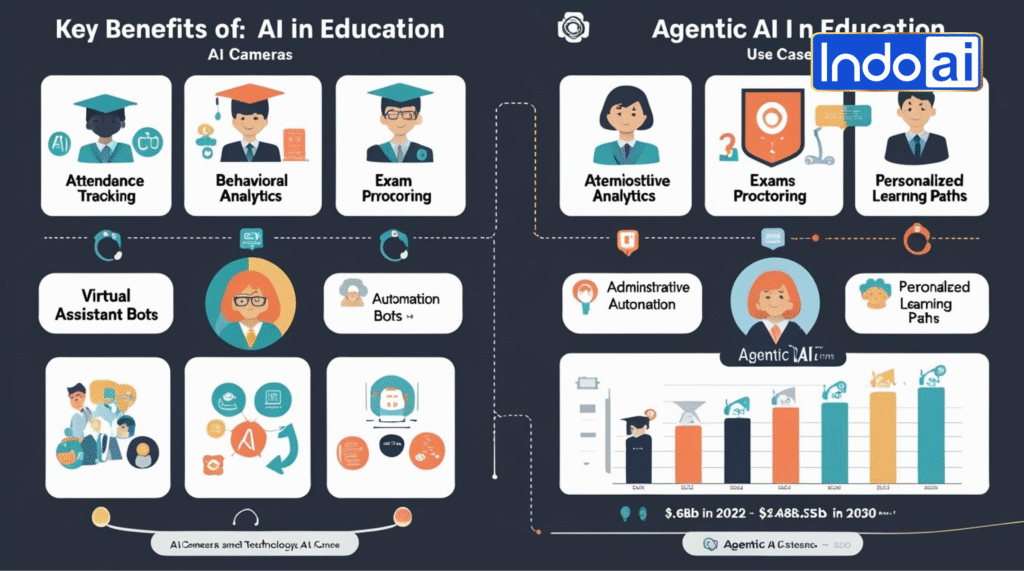
- AI Cameras:
- Attendance Management: AI cameras using facial recognition automate attendance tracking, reducing manual errors.
- Behavior Monitoring: These cameras can identify and report incidents like bullying, unauthorized access, or emergencies.
- Exam Proctoring: AI cameras monitor exam halls, flagging suspicious activities and ensuring fairness.
- Agentic AI Systems:
- Virtual Assistants: AI-powered chatbots answer student queries, assist with assignments, and provide reminders for deadlines.
- Administrative Tools: From managing fees to scheduling classes, these systems reduce administrative workload.
- Learning Platforms: Adaptive learning systems use AI to customize study plans, offer real-time feedback, and track progress.
- Hybrid Solutions: Combining AI cameras with agentic AI systems creates seamless interactions. For example, when a student enters a library, AI can recommend resources based on their academic profile.
Real-Life Examples of AI in Education
- Stanford University: AI cameras are deployed to monitor campus safety, using advanced analytics to detect crowd anomalies.
- University of Southern California: The university integrates AI-driven platforms to deliver personalized learning experiences.
- Indian Schools: State education departments in India have implemented AI-based attendance systems, enhancing teacher accountability and student engagement.
- Pearson and Coursera: These global education companies use AI to offer adaptive learning, ensuring every student’s journey is optimized for success.
Insights and Market Size
- According to Grand View Research, the global AI in education market was valued at $3.68 billion in 2022 and is projected to reach $48.35 billion by 2030, growing at a CAGR of 36%.
- In India, the EdTech market—a major adopter of AI—is set to expand from $2.8 billion in 2020 to $10.4 billion by 2025 (RedSeer Consulting).
Famous tech visionary Bill Gates once remarked, “Technology is just a tool. In terms of getting kids working together and motivating them, the teacher is most important.” AI enhances, rather than replaces, the educator’s role, making learning environments more dynamic and effective.
Challenges and Ethical Considerations
- Privacy Concerns: AI systems collect sensitive data, raising questions about privacy and data protection. Institutions must ensure compliance with data security laws like GDPR.
- Infrastructure Gaps: Many schools, particularly in developing countries, lack the resources needed for AI deployment.
- Cost Barriers: High implementation costs deter smaller institutions from adopting AI solutions.
- Ethical Dilemmas: Balancing automation with human oversight is crucial. Can AI truly capture the nuances of human interaction?
The Future of AI in Education
Despite challenges, AI’s potential to revolutionize education is undeniable. It can:
- Make learning more inclusive with tools like real-time language translation and assistive technologies.
- Enhance learning outcomes by identifying gaps and offering targeted interventions.
- Equip institutions with data-driven strategies for decision-making.
As the global AI in education market continues to grow, driven by innovations from tech giants like Google, Microsoft, and IndoAI, the education sector is poised for a transformation. AI will not only augment teaching and learning but also create environments where every student has the opportunity to succeed.
The question is not if AI will transform education but how quickly institutions can adapt to harness its full potential. By embracing AI, we’re not just preparing students for the future—we’re creating it.