If you run a factory or warehouse, you’ve already experienced the gap between “CCTV installed” and “risk reduced.” In 2025, that gap is widening because the industrial footprint is expanding while expectations on uptime, compliance, and incident response are tightening.
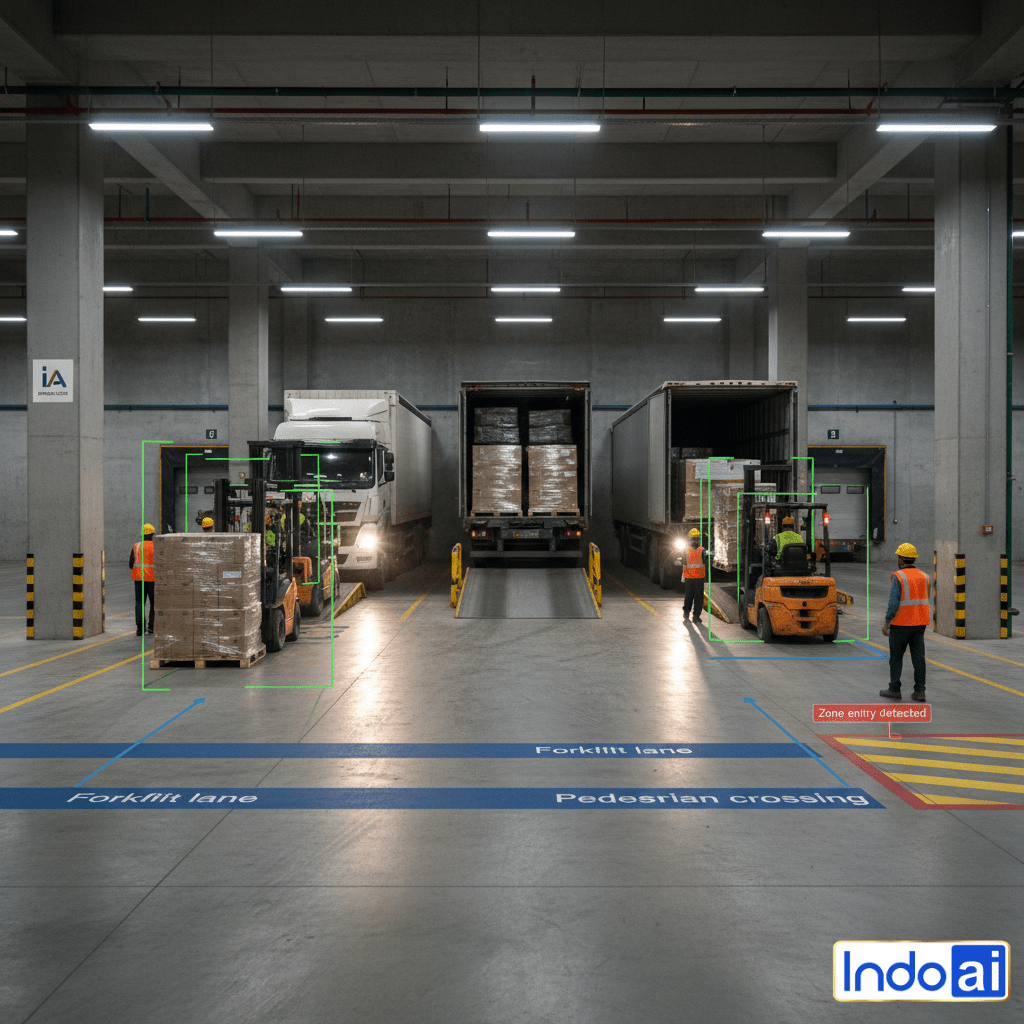
Two realities define the year:
- Warehousing scale is increasing, and Grade A facilities are rising. Knight Frank reports H1 2025 transaction volumes up 42% YoY to 2.98 million sq m, with 63% of transacted area in Grade A spaces (vs 54% in H1 2024). Knight Frank+1
- Industrial safety remains a measurable problem. DGFASLI’s Standard Reference Note shows fatal injuries in registered factories at 1,017 in 2022 and non-fatal injuries at 2,714 in 2022, alongside cause-wise breakdowns that are directly relevant to plant operations. DG FASLI
This is why “best AI camera for factories and warehouses in India” is not a camera-shopping question. It’s a systems question:
- Can it prevent incidents or reduce time-to-intervention, not just record footage?
- Does it still work when connectivity degrades (a common reality on industrial sites)?
- Can it integrate with your existing CCTV/NVR/VMS without a rip-and-replace?
- Can you start small, prove ROI, and scale use-cases without rebuilding the entire stack?
This guide answers those questions with design math, deployment patterns, procurement checklists, and a clear recommendation lens that reflects Indian industrial constraints.
Table of contents
What changed in 2025 (why “CCTV installed” is not enough)
More space, more throughput, more complexity
Grade A warehousing growth usually brings larger footprints, higher rack density, stricter dock SLAs, more vehicle movement, more contractors, and more shift-change surges. The result is simple: you cannot “monitor harder” with human eyes alone.
Compliance is becoming a procurement filter India’s CCTV security compliance direction is no longer theoretical. BIS implementation guidelines note:
“Beyond 09 April 2025 no Licence for CCTV cameras shall be granted without compliance to ‘Essential Requirement(s) for Security of CCTV’…” CRS BIS
Even if you are not the manufacturer, enterprise procurement and tenders increasingly ask for security posture, update policies, and hardening documentation because the compliance burden flows downstream.
The KPI shift: from recording to response
In industrial environments, video is only useful when it produces:
- a trusted alert (low false alarms)
- a consistent SOP (who responds, how quickly, and how closure is recorded)
- searchable evidence (so investigations do not consume days)
The architectures that work in Indian factories and warehouses
There are three ways industrial buyers deploy AI video analytics. In India, hybrid is the most practical outcome for many sites.
A) Edge AI (AI runs on the camera or near-camera)
Best when you need reliability even with weak internet, and you want real-time alerts with minimal bandwidth.
Axis describes its edge analytics clearly: “detect, classify, track, and count humans, vehicles, and types of vehicles,” and supports running multiple scenarios simultaneously. Axis Communications+1
What edge is great at in factories: perimeter intrusion, line-crossing, loitering in defined zones, people/vehicle classification, basic counting.
B) On-prem AI for existing CCTV (AI box approach)
Best when you have many existing cameras, strict locality requirements, or a mature NVR/VMS estate and want analytics without replacing cameras.
Where on-prem wins: multi-stream analytics at scale, campus-style plants, and sites with strict IT rules.
C) Cloud-managed AI platform
Best for multi-site operators who want standardization, remote management, and fast investigation workflows.
Rhombus positions itself with transparent packaging and warranty language. Its pricing page states: “All cameras include 10-year warranties.” Rhombus+1
Its manufacturing case study for Metalsa cites “over 350 dedicated training clips” created using their console, which is an operational outcome many safety leaders care about. Rhombus
The India reality: Hybrid
A practical pattern that fits many Indian sites:
- edge analytics for immediate alerts and resilience
- on-prem for storage and heavy analytics
- cloud for notifications, dashboards, and multi-site visibility
This “hybrid by design” approach is one reason IndoAI focuses on edge-first architecture and modular upgrades.
Use-cases that reliably justify budget in India
Most plants should start with 3–5 use-cases, not 15. Industrial ROI comes from focused deployment and disciplined thresholds, not feature sprawl.
Safety (EHS-led)
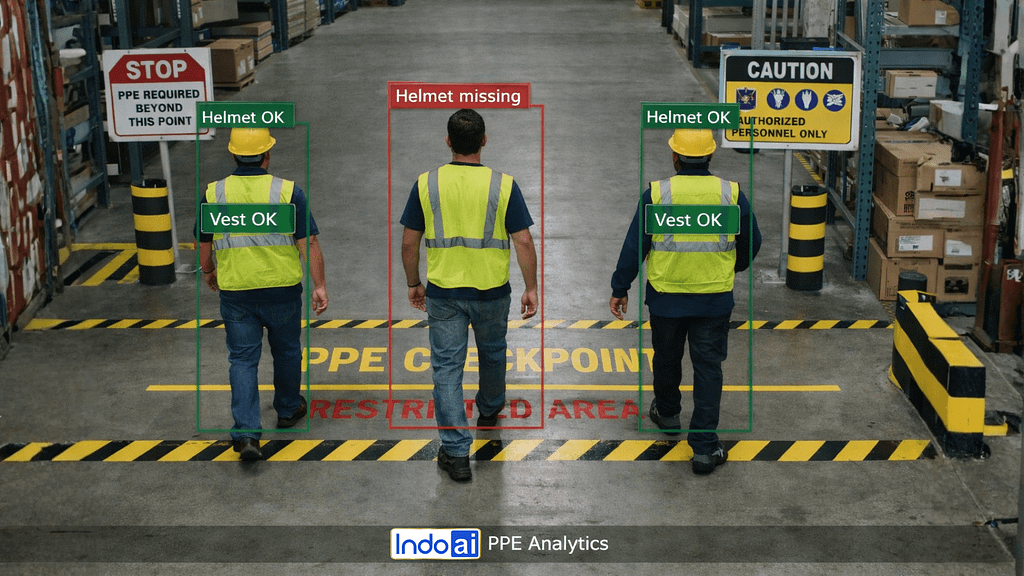
- PPE compliance in defined zones
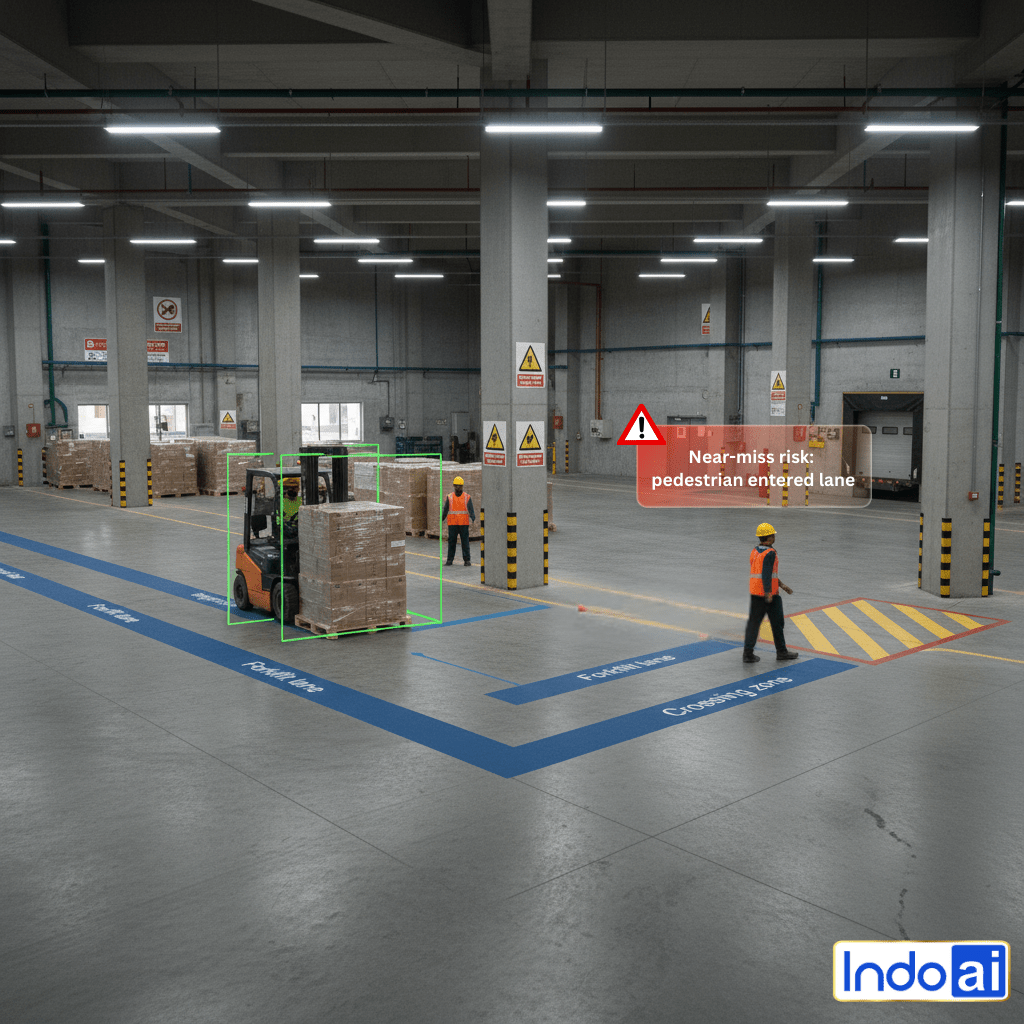
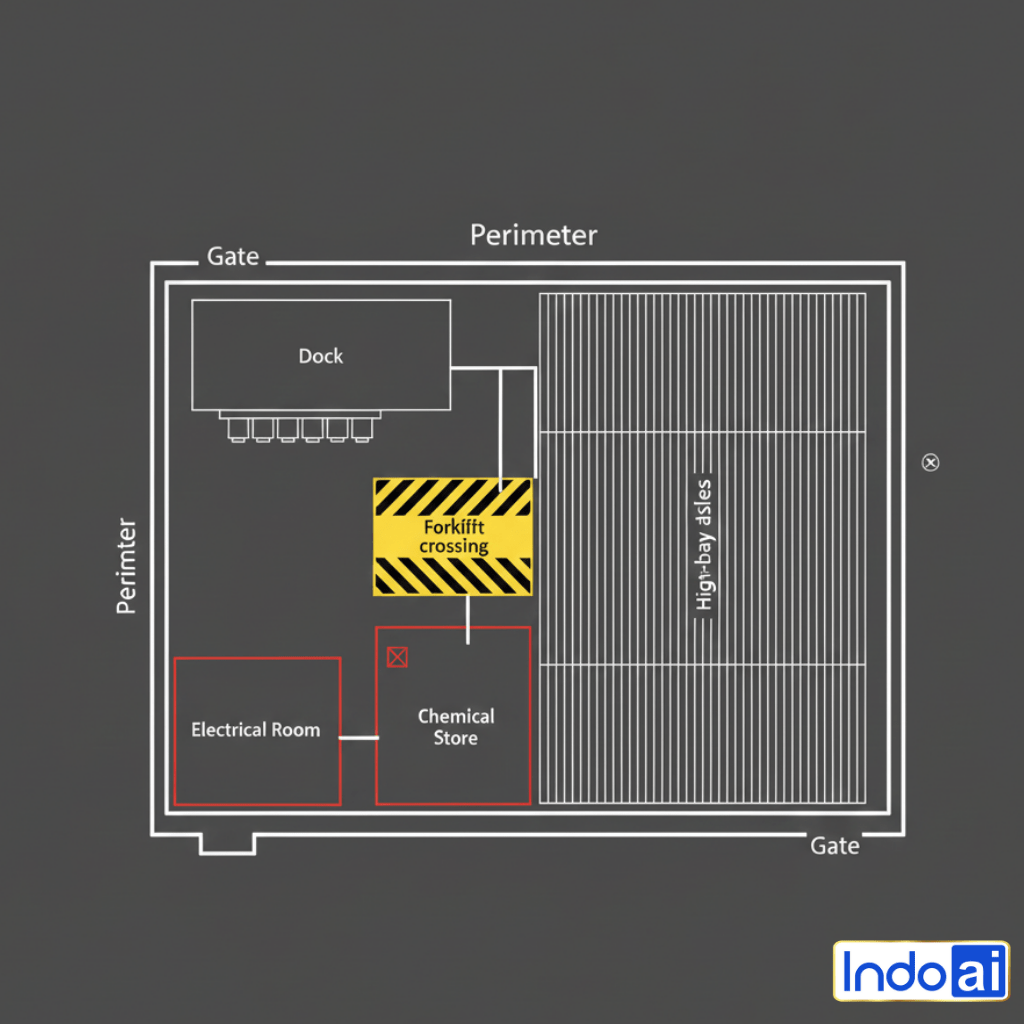
- Forklift–pedestrian near-miss detection at crossings and blind turns
- Restricted zone access (electrical rooms, chemical stores, machine guarding)
- Loitering in hazardous zones (time-in-area)
- Fire and smoke early warning
Security (loss prevention and perimeter)
- Perimeter intrusion and yard movement anomalies
- Gate integrity: tailgating, after-hours movement, unauthorized entry
- Visitor and contractor logging with strict governance (especially if biometrics are used)
Operations (warehouse manager)
- Dock dwell time and queue build-up
- SOP adherence during loading/unloading (zone-based checks)
- Shrinkage hotspots (after-hours motion, unusual patterns)
- Investigation speed: searchable events, not manual rewind
A useful benchmark: Metalsa’s example shows how incident clips can become a repeatable training library (350+ clips). That’s the difference between “analytics installed” and “operations improved.” Rhombus
Camera placement and pixel density: the part most vendors skip
If AI underperforms, it is often not the model. It is mounting height, lensing, glare, and pixel density.
Axis publishes planning guidance aligned to IEC 62676-4, describing operational needs (detection, observation, recognition, identification). Axis White Papers+1
A common DORI mapping used in the industry is:
- Detection: 25 pixels/m
- Observation: 62 pixels/m
- Recognition: 125 pixels/m
- Identification: 250 pixels/m Infiniti Electro-Optics+1
Practical heuristics (industrial reality)
- Gates: use one wide context view and one tighter view for plates/driver face; plan lighting to prevent headlight washout
- PPE zones: mount at an angle where helmets/vests are clearly visible; avoid top-down views that hide PPE
- Forklift crossings: choose angles that show both pedestrian entry and forklift approach; define zones to control false alarms
- High-bay aisles: ensure enough pixels on a person at the far end; long focal lengths are often required
The shortlisting checklist (what serious industrial buyers demand)
If a proposal lacks these, it’s not an industrial design, it’s a brochure.
Site survey outputs (non-negotiable)
- Zone map (gates, docks, aisles, perimeter, hazardous rooms)
- Pixel density plan per use-case Axis White Papers+1
- Lighting plan (day/night, glare hotspots, IR reflection risks)
- Network plan (PoE budget, switching, VLAN segmentation, bandwidth)
- Storage plan (retention, export workflow, evidence handling)
- Alert workflow SOP (verify, escalate, close, audit)
- False-alarm plan (tuning window, thresholds, feedback loop)
- Cyber plan (roles, password policy, firmware updates)
- Compliance note referencing BIS CCTV security requirement direction CRS BIS
- Integration plan using ONVIF (and a pilot test plan)
ONVIF Profile S is explicitly designed for IP video systems and describes how devices stream to clients like VMS platforms. ONVIF+1
Acceptance tests you should put in the PO
Define for each use-case:
- max false alarms per day per camera
- alert latency target
- degraded behavior during WAN outage
- evidence export requirement (clip + metadata)
- stress tests (dust, rain, glare, shift change surges)
IndoAI vs Axis vs Rhombus: which fits which industrial reality (and why IndoAI is structurally advantaged in India)
This section is written the way we evaluate systems internally, not as brand marketing.
First, the hard constraint most Indian plants share
Across industrial India, security systems face at least one of these constraints:
- inconsistent internet or bandwidth bottlenecks
- mixed camera estates (legacy IP cams + newer models)
- heavy dependence on guards and supervisors for verification
- the need to roll out use-cases in phases, site-by-site
This constraint is why edge-first and modular deployment patterns matter more here than in many Western campuses.
Axis: strongest benchmark for enterprise ecosystem-led deployments
Axis is often the reference point when a plant wants an enterprise-grade ecosystem and documented edge analytics.
Axis Object Analytics states it can “detect, classify, track, and count humans, vehicles, and types of vehicles” and supports running multiple use-cases simultaneously with triggers. Axis Communications+2Axis Help+2
When Axis tends to be the right fit
- You already run a mature VMS environment and have strong SI support
- You want a “standards-first, ecosystem-first” deployment model
- You are optimizing for broad interoperability and long lifecycle planning
What to watch
- Total system cost across cameras, licenses, and integration effort
- False alarms in dusty/reflective/steam-heavy environments without a formal tuning plan
Rhombus: strongest fit for cloud-managed, multi-site operational simplicity
Rhombus is designed around a centralized operator experience and rapid investigation workflows.
- Their pricing page states: “All cameras include 10-year warranties.” Rhombus+1
- Their Metalsa case study cites “over 350 dedicated training clips” created via their console, an example of how video becomes operational training content. Rhombus
When Rhombus tends to be the right fit
- You run multiple sites and want one console for search, alerts, and visibility
- You want fast triage and standardized workflows
- You can support the connectivity and governance model of cloud-managed operations
What to watch
- What continues to work during WAN outages
- India-specific support availability and replacement logistics
IndoAI: built around India’s most common industrial constraints (edge-first reliability + modular “AI apps”)
IndoAI is designed around a different starting assumption: industrial outcomes should not depend on constant cloud connectivity.
IndoAI states its cameras “process data directly on the device,” reducing the need for constant cloud connectivity and bandwidth costs. Indo.ai+1
IndoAI also positions itself as an edge AI camera platform where you can “install, upgrade, or switch AI models like apps.” Indo.ai+1
This matters for factories and warehouses because industrial rollouts are rarely one-shot purchases. They evolve:
- Phase 1: perimeter + gate + fire/smoke
- Phase 2: PPE + restricted zones
- Phase 3: forklift crossings + SOP analytics + operations dashboards
A modular “AI apps” model is structurally aligned to how Indian plants actually buy.
Where IndoAI typically wins in industrial India
- Reliability under imperfect connectivity: If detection runs locally on the device, alerting can be designed to degrade gracefully rather than failing completely during network drops. Indo.ai+1
- Phased rollouts without system redesign: Adding a new use-case should not require new NVR logic, new camera replacement, or rebuilding the pipeline. IndoAI’s Appization concept is explicitly framed as installable/upgradable models. Indo.ai+1
- Faster path from “use-case request” to “model availability”: IndoAI’s Appization page describes a workflow to request a model and fund its creation via a bounty, which is an industrial-friendly path when plants have niche SOP needs (for example, a specific forklift crossing layout). Indo.ai
- Multi-model edge processing as a design goal: IndoAI describes a modular camera system using GPU modules to run multiple AI models at once for low latency, which is directly relevant when you want to combine safety plus security analytics on the same streams. Indo.ai
What we recommend buyers validate with IndoAI
- a zone-by-zone acceptance test (false alarms/day/cam, latency, stress conditions)
- integration path with your existing VMS (ONVIF streaming and event routing)
- governance pack (roles, audit logs, update policy, retention)
Research inference
If your plant reality includes bandwidth constraints, mixed infrastructure, and incremental expansion of use-cases (which is common in India), then an edge-first system with modular model upgrades is not just “nice,” it reduces total rollout friction and improves the probability of adoption.
A 30–60–90 day deployment plan (pilot to scale)
Days 1–30: Pilot for signal quality, not vanity demos
- Choose 3 views: one gate, one dock, one aisle/crossing
- Run 1–2 analytics per view
- Start with silent mode for tuning
- Define SOP: acknowledge, verify, escalate, resolve
Deliverables
- baseline incident log
- false alarm rate and tuning actions
- network/storage health report
- integration feasibility confirmed
Days 31–60: Expand to the risk-map
- Add perimeter zones and restricted zones
- Add dock dwell time if operations sponsors
- Weekly review: false positives, misses, response times
Days 61–90: Operationalize and measure ROI
- Convert repeat incidents into a training library
- Lock governance: roles, audit, retention
- Publish scale plan: CAPEX/OPEX clarity, use-case roadmap, KPI targets
Compliance and governance in India (BIS, ONVIF, DPDP)
BIS CCTV security requirements direction
BIS implementation guidelines explicitly reference the April 9, 2025 compliance line for licensing. CRS BIS
For enterprise procurement, treat this as a signal to demand:
- device security posture documentation
- firmware update policy
- access control and audit logs
ONVIF interoperability
ONVIF Profile S defines IP video streaming interoperability between devices and clients like VMS platforms. ONVIF+1
In practice, always pilot-test: live stream stability, PTZ control where relevant, audio/metadata needs, and event handling.
DPDP Act and Rules
xIndia notified the DPDP Rules, 2025 (PIB note) and this operationalizes the DPDP Act, 2023. Press Information Bureau+1
If you use face recognition or any personal-data-heavy workflow, you need clear retention, access control, and signage practices.
FAQs
What is the best AI camera for factories and warehouses in India?
Can I add AI analytics to my existing CCTV setup?
How do we reduce false alarms in dusty, reflective, high-movement environments?
Call to action
If you want to avoid a mis-buy, do one thing first: map your risk zones, select three pilot views, and require every vendor to submit a pixel density plan, a false-alarm plan, and an alert SOP before you compare pricing.
If you share your facility type and a rough layout (gates, docks, aisles, perimeter length), we can convert this into a pilot blueprint with recommended camera placements, the first 5 analytics packs, and measurable acceptance tests.