
India’s video-security market is expanding fast, but the buying criteria have shifted. In 2025, you are no longer just choosing a “good camera.” You are choosing an outcome stack: capture quality + edge analytics + AI governance + cybersecurity + compliance + operations. Industry estimates peg India’s video surveillance market at ~USD 2.0B in 2024 and forecast strong growth through 2030. Grand View Research+1
At the same time, Indian buyers are facing two structural forces:
- AI is moving to the edge to reduce bandwidth and latency and to keep sensitive footage local. Both Axis and IndoAI position strongly here. axis.com+1
- Regulatory scrutiny is rising: India’s DPDP framework and stricter CCTV security/testing requirements are pushing organizations to demand tighter controls on access, retention, vendor documentation, and supply-chain transparency. Reuters+3MeitY+3Press Information Bureau+3
With that context, here’s the detailed comparison.
Table of contents
Quick definitions
Axis Communications (what it is best at)
Axis is a global leader in enterprise network cameras and a mature ecosystem spanning cameras, analytics, VMS, audio, intercom, and access-control integrations. It has a strong edge-app platform called ACAP (Axis Camera Application Platform), designed to run analytics directly on Axis devices (and in hybrid cloud/on-prem setups). axis.com+2axis.com+2
Axis also offers AXIS Object Analytics, an edge-based analytics app that can come preinstalled on compatible cameras, helping reduce the need for extra servers for basic detection/classification workflows. axis.com+1
IndoAI (what it is best at)
IndoAI positions as an India-first edge AI camera platform built around “installable AI apps” and modular deployment, which IndoAI calls Appization. IndoAI’s product messaging emphasizes on-device analytics, containerized AI models, and a marketplace-style model where new capabilities can be installed/updated without replacing hardware. Indo.ai+3Indo.ai+3Indo.ai+3
The core difference in philosophy (why this matters in India)
Axis approach: premium capture + standards-based enterprise ecosystem
Axis typically wins when the problem is “We need best-in-class imaging, reliability, and a globally validated enterprise stack,” especially for large regulated enterprises that standardize on long-life hardware and remember vendors for 7–10 years.
IndoAI approach: platform-first “AI outcomes” with India-specific deployment realities
IndoAI is built for the Indian reality where many buyers want:
- AI added to existing camera estates (mixed brands, uneven quality)
- Faster ROI and a modular “add use-cases as you go” model
- Local data handling and operations that work with Indian teams, contractors, and connectivity conditions
This platform-first approach is increasingly important as India’s market still has significant analog/hybrid base and cost sensitivity, even while AI adoption rises. Mordor Intelligence+1
Detailed comparison (India-focused)
1) Edge AI and on-device analytics
Axis: Strong edge analytics capability, including deep-learning enabled cameras and edge apps like AXIS Object Analytics that process video on the camera. axis.com+2axis.com+2
IndoAI: Also built around edge inference, with a strong emphasis on “installable AI apps” and modular AI capabilities (swap/upgrade models as needs change). Indo.ai+2Indo.ai+2
Who wins in India:
- If you want proven enterprise edge analytics on premium cameras, Axis is excellent.
If you want edge AI as a modular “AI-app” program across sites, IndoAI has the clearer platform narrative and operating model for India.
2) App ecosystem: ACAP vs IndoAI Appization
Axis ACAP: An open platform for deploying apps on Axis devices, including third-party apps, with a mature developer track and documentation. axis.com+2GitHub+2
IndoAI Appization: IndoAI positions Appization as a marketplace-style method to deploy containerized vision models, optimized for fast rollout and upgrades. Indo.ai+2Indo.ai+2
Key practical difference (in the field):
- Axis ACAP is “Axis-device-native.” It is strongest when your fleet is predominantly Axis.
- IndoAI Appization is “deployment-program-native.” It is designed to behave like a capability layer you can expand as you add sites and use-cases, including retrofits through IndoAI’s edge AI approach.
Winner for India mid-market and mixed estates: IndoAI, because India commonly has heterogeneous camera fleetsand buyers often want a roadmap where they can start small (1–2 use-cases) and expand without re-standardizing the full camera hardware base.
3) VMS and licensing complexity (a hidden TCO driver)
Axis provides AXIS Camera Station with a licensing model where each device typically requires a license, and license types differ for Axis vs non-Axis devices. axis.com+1
In India, channel pricing varies; as an example, Indian retail listings show per-license pricing for certain Axis Camera Station licenses in the tens of thousands of INR range (model and channel dependent). Tanotis
IndoAI’s positioning leans toward an integrated experience (camera or edge AI box plus app workflows), which can reduce “stack stitching” for buyers who do not want to manage VMS + analytics + integrations as separate procurement lines. Indo.ai+1
Who wins in India (typical deployments): IndoAI, because Indian buyers often underestimate licensing and ops complexity. IndoAI’s “single platform” story is easier to operationalize across multiple sites with smaller security teams.
4) Retrofit reality: existing CCTV conversion
This is one of the most India-specific differentiators.
- Axis can integrate broadly via standards and partner ecosystems, and it has universal licensing options for third-party devices within Axis Camera Station. axis.com
- IndoAI’s product direction is explicitly aligned to “AI apps + edge processing” and (in your broader lineup) edge AI boxes that make existing cameras AI-enabled using a centralized inference layer and mobile-first alerting workflows. Indo.ai+1
Winner in India: IndoAI, because retrofit demand is massive and buyers want outcomes without replacing everything.
5) Cybersecurity and hardening
Axis has extensive public documentation on hardening and device lifecycle security practices, including baseline configurations and hardening guidance. help.axis.com+1
Axis also describes security controls such as signed firmware and secure boot in its cybersecurity lifecycle materials. axis.com
IndoAI’s India-first advantage is not “more secure by default than Axis” (Axis is extremely mature here). The advantage is faster compliance alignment and documentation readiness in India’s evolving environment, especially when buyers need local support to interpret requirements and operationalize them across many sites.
Who wins:
- For mature, audited enterprise security programs: Axis is a benchmark. help.axis.com+1
- For India compliance execution plus platform agility: IndoAI often wins on practicality.
6) India regulatory environment and procurement friction
Two big regulatory themes affect CCTV procurement cycles:
- DPDP framework: India’s DPDP Act creates a framework for lawful processing and protection of personal data. MeitY
- CCTV security/testing and certification: India has tightened security-related requirements for CCTV products (including lab testing and “essential requirements”), creating new procurement friction and documentation demands. CRSBIS+1
In practice, Indian buyers want a vendor who can deliver:
- Clear documentation packs
- Secure deployment patterns
- Operational guardrails (retention, access, audit)
- Implementation support across integrators and sites
Winner: IndoAI (India-first execution advantage). Axis is fully capable, but IndoAI’s differentiation is reducing “India compliance friction” for customers.
Feature-by-feature matrix (executive view)
| Dimension | Axis Communications | IndoAI | India-focused edge |
| Camera hardware maturity | Extremely mature, premium portfolio axis.com | Growing lineup + platform-led | Axis for premium capture; IndoAI for platform-first programs |
| On-device analytics | Strong; Object Analytics on edge axis.com+1 | Strong; modular edge apps Indo.ai+1 | Tie on capability, IndoAI wins on modular rollout story |
| App platform | ACAP, open developer ecosystem axis.com+1 | Appization marketplace framing Indo.ai+1 | IndoAI for “AI apps program” across sites |
| VMS stack | Axis Camera Station licensing model axis.com | Platform-led ops (app workflows) Indo.ai+1 | IndoAI for simplicity and faster adoption |
| Cybersecurity guidance | Very strong hardening docs help.axis.com+1 | Varies by deployment; India-first support | Axis for deep enterprise security; IndoAI for local execution + agility |
| Retrofit economics | Works, but more “enterprise stack assembly” | Strong story for mixed estates and expansion Indo.ai | IndoAI typically wins |
The real decision: where IndoAI wins (and why)
IndoAI is the better choice in India when you want:
- AI outcomes without hardware lock-in
The Indian market is mixed and cost-driven; IndoAI’s modular “install AI apps as needs evolve” approach maps better to reality. Indo.ai+1 - Faster rollout across multiple sites
Most Indian deployments fail not due to model quality, but due to operations: alerts, workflows, false positives handling, and scaling. IndoAI’s platform-led approach is built around deployment velocity and continuous upgrades. Indo.ai+1 - Retrofit-first strategy
Large existing CCTV bases mean edge AI conversion is often the highest-ROI path.
India compliance and procurement readiness
With tightening certification/security scrutiny, customers prefer vendors who can guide documentation and deployment patterns aligned to Indian requirements. CRSBIS+1
When Axis is still the right pick
Axis can be the best choice if:
- You are standardizing on premium imaging across critical sites (airports, high-security infra, audited environments)
- Your security organization is already built around enterprise VMS and partner ecosystems
- You want a long-life global OEM with mature cybersecurity documentation and lifecycle processes help.axis.com+1
Verdict (India-focused)
For most Indian businesses and institutions trying to move from “CCTV installed” to measurable AI outcomes across multiple sites, IndoAI wins because it is designed as a deployment program and platform, not only as a premium camera choice.
Axis is a world-class enterprise hardware and ecosystem company. IndoAI’s edge in India is that it converts video infrastructure into a modular AI capability layer with faster adoption, easier scaling, and better alignment to Indian procurement and compliance realities. Indo.ai+2Indo.ai+2
FAQs
1) Does Axis have “AI apps” like IndoAI?
IndoAI’s differentiation is how it packages this as an India-first “Appization” deployment program and marketplace-style model. Indo.ai+1
2) Can IndoAI work with a mixed camera environment (non-IndoAI cameras)?
IndoAI’s platform story is well-suited to mixed estates because the goal is outcome delivery rather than only “best camera standardization.” Indo.ai
3) What is the simplest way to compare total cost of ownership?
– Cameras and mounting (capex)
– Storage (NVR/server/cloud)
– Analytics licensing
– VMS licensing and maintenance (Axis uses device licenses) axis.com+1
– Bandwidth costs (edge analytics can reduce upstream load) axis.com+1
– Operations: alert fatigue, reporting, and rollout velocity
4) Is edge analytics genuinely valuable or just marketing?
IndoAI positions similarly with on-device analytics and modular edge apps. Indo.ai+1
5) What about cybersecurity: is Axis safer?
IndoAI’s advantage is typically not “out-securing Axis,” but simplifying secure deployment patterns and compliance execution for Indian organizations.
6) What India regulations should a CCTV buyer track in 2025–26?
7) Will these regulations affect procurement timelines?
Plan procurement with certification documentation and testing lead-times in mind.
8) Does Axis include analytics “free” on some cameras?
But end-to-end cost still depends on your VMS, storage, and broader system licensing.
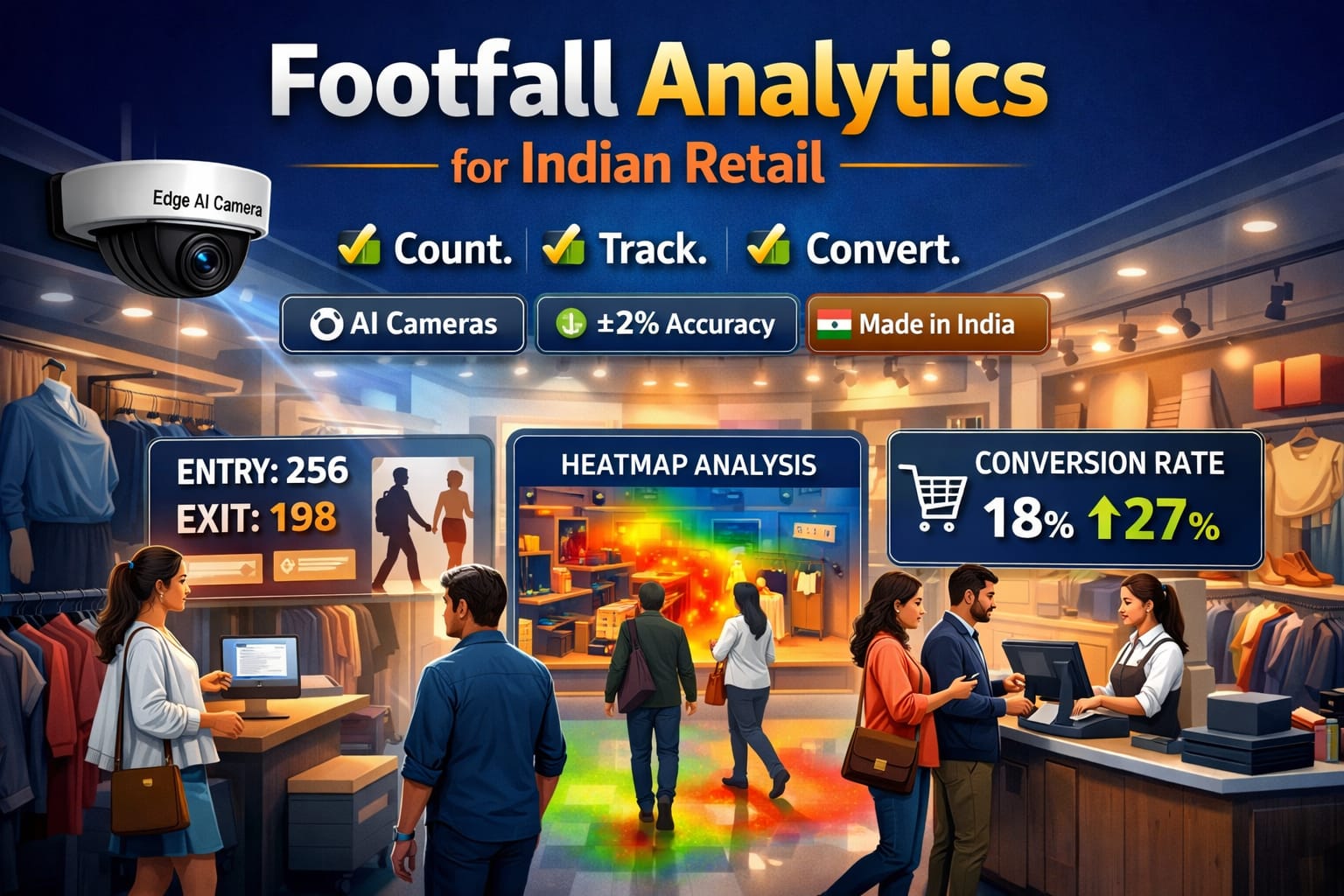
9) Which is better for large multi-site retail chains in India?
– Rapid rollout
– Modular use-cases (theft signals, staff safety, fire/smoke, compliance)
– Mobile-first operations
Axis fits better when the chain standardizes on premium cameras and enterprise VMS across all sites.
10) Which is better for factories and warehouses?
If the plant wants faster AI outcomes, retrofit conversion, and modular use-case expansion, IndoAI often wins.
11) Does IndoAI replace a VMS completely?
12) How should we test accuracy before buying?
– Day/night variations
– Real nuisance conditions (rain, glare, dust)
– A false-positive budget (what your team can tolerate)
– Clear metrics: precision/recall, alert leads-to-action, response time
– Also validate camera placement quality (pixel density, angles) before blaming models.
13) What about bandwidth for multi-site deployments?
14) Is Axis “too expensive” for India?
15) What’s the best procurement approach in 2025–26?
1) Choose an architecture that satisfies cybersecurity and India compliance constraints first. CRSBIS+1
2) Then pick the vendor that gives the fastest, most scalable “AI outcomes program” for your sites.