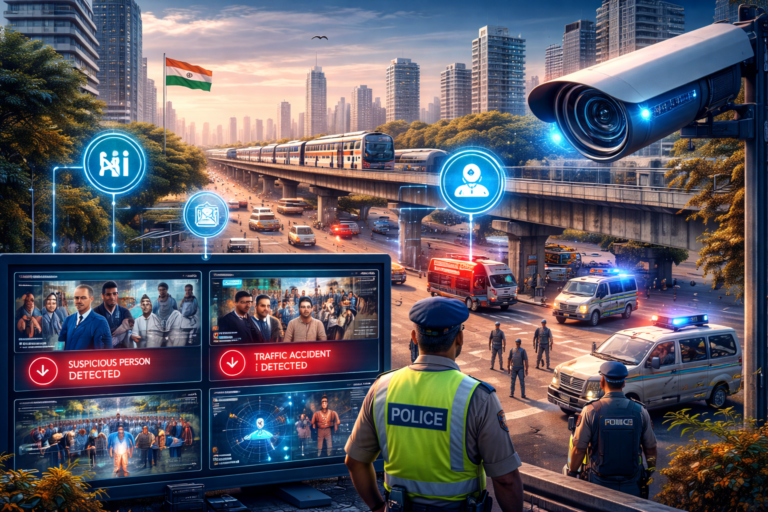

Small businesses in India don’t have a surveillance problem — they have a loss, safety, and operations problem. From cash counter disputes and staff pilferage to inventory shrinkage and after-hours intrusion, traditional CCTV records incidents but rarely prevents or resolves them.
In 2025, AI-powered CCTV systems are helping kirana stores, pharmacies, cafés, cloud kitchens, clinics, factories, and retail outlets reduce losses by delivering actionable alerts instead of endless footage.
This buyer’s guide explains what “cost-effective AI CCTV” really means in India, realistic pricing ranges, DPDP compliance considerations, and how small businesses can upgrade existing CCTV without expensive replacements.
Target reader: kirana and mini-supermarkets, pharmacies, clinics, cafes and cloud kitchens, small factories and warehouses, jewellery and fashion retail, coaching institutes and schools, housing society offices.
Small businesses in India don’t have a “surveillance” problem. They have a loss + safety + ops problem.
- Loss: theft, cash counter disputes, staff pilferage, inventory shrinkage, and supplier delivery mismatches. Large Indian retailers have publicly reported shrinkage rising in FY24 (examples: Trent, V-Mart). Business Standard+1
- Scale: India’s registered MSME base is massive (Udyam + Udyam Assist Platform counts are in crores), which means even “small” improvements compound across millions of outlets. India Brand Equity Foundation+1
- Market reality: India’s video surveillance market in 2025 is estimated in the multi-billion-dollar range and growing, with IP migration and edge analytics accelerating. Mordor Intelligence
- Compliance: India’s DPDP Act and the DPDP Rules update increase the importance of privacy-by-design and reasonable security safeguards for any system processing personal data. MeitY+2Press Information Bureau+2
This guide breaks down what “cost-effective AI” really means in 2025, how to choose the right architecture, what it should cost (realistic India ranges), and how IndoAI fits as a practical path for small businesses who want enterprise-grade capability without enterprise complexity.
Table of contents
What “cost-effective AI CCTV” actually means (and what it does not)
Cost-effective is not “cheapest camera on Amazon.”
For small businesses, cost-effective means:
- Low total cost of ownership (TCO) over 3 years
Hardware + storage + maintenance + downtime + false alarms. - Actionable alerts, not more video
You want “events” and “answers,” not 2TB of footage nobody checks. - Works with real Indian constraints
Unreliable internet, power fluctuations, mixed camera brands, limited IT skills, and multi-site owners.
Privacy-safe by default
Clear retention, access control, and secure storage aligned to India’s DPDP expectations. MeitY+2Press Information Bureau+2
The 3 architectures that win for small businesses in India (2025)
A) AI cameras (analytics inside the camera)
Best when you are buying new cameras anyway and want simpler wiring.
Typical edge analytics capabilities exist in many AI camera lines (intrusion, loitering, line crossing, tamper, etc.). Honeywell
Where it fails for small businesses:
- Vendor lock-in on VMS apps
- Uneven analytics quality across price tiers
- Harder to unify multiple camera brands
B) Edge AI Box (connect your existing cameras and add AI)
Best when you already have cameras installed (common in India).
Why it is cost-effective:
- You reuse your existing CCTV investment
- AI becomes a “layer” you can upgrade without replacing all cameras
(IndoAI’s approach here is typically: keep cameras, add IndoAI Edge AI Box, deliver alerts and event clips to the IndoAI app, and let customers add AI capabilities as needed.)
C) Cloud-managed “AI camera platforms”
These are popular in the US. They often bundle hardware + cloud subscription and optimize UX.
Reality check for Indian small businesses:
- Ongoing USD subscriptions can dominate TCO
- Always-online dependence is risky for many sites
- Data residency and privacy expectations require extra care
Example: Verkada publishes cloud license pricing per camera per year (USD). Verkada+1
Spot AI describes pricing as recurring, based on number of camera feeds, storage days, and term (often quote-based). Spot AI
IndoAI’s “small business” philosophy (why we exist in this category)
Most small businesses don’t want to become security engineers.
IndoAI is built around 3 ideas:
- On-edge intelligence that works even when connectivity is imperfect.
- Appization: install and upgrade AI capabilities like apps, not like custom projects.
- A practical path for both worlds:
- IndoAI AI-enabled cameras for fresh installs
- IndoAI Edge AI Box for existing CCTV upgrades
So a 6-camera shop can start small (people + intrusion alerts), and later add higher-value AI “apps” (shoplifting patterns, PPE detection for small factory floors, fire/smoke, vehicle analytics, queue insights) without redoing the entire system.
A realistic 2025 pricing guide (India) for small businesses
Prices vary by lens quality, sensor, low-light performance, warranties, and channel margins. Use ranges to plan budgets.
1) Base CCTV (no AI)
- 2MP IP cameras are commonly seen around the low thousands INR in retail channels. Amazon
- Entry NVR pricing for small channel counts is also commonly in the low thousands INR in India retail channels. Amazon
But base CCTV alone rarely reduces losses unless someone is watching.
2) “AI camera platform” model (hardware + subscription)
- Verkada’s published cloud license pricing shows per-camera annual licensing in USD, plus hardware. Verkada+1
- This model can be great UX, but often lands expensive for India’s price-sensitive SMB segment once you include multi-year licensing.
3) IndoAI approach (practical SMB tiers)
Think in tiers, not in devices.
Tier A: Starter (single outlet)
- 4 to 8 cameras
- IndoAI AI-enabled cameras or existing cameras + IndoAI Edge AI Box
- Alerts: intrusion, loitering, staff entry zones, tamper, basic fire/smoke where needed
Tier B: Growth (higher-risk retail)
- 8 to 16 cameras
- Add: people search, vehicle search, hot-zone alerts, higher-quality night capture
- Add: role-based access (owner, manager, auditor)
Tier C: Multi-site owner
- 3 to 20 outlets
- Central dashboard, standard SOPs, standardized retention and privacy policy, and “same alerts everywhere”
This tiering is what keeps TCO controlled: you pay for outcomes, not for fancy specs.
How to choose the right setup in 12 minutes (decision checklist)
Step 1: Decide what you are protecting
Pick the top 2:
- Cash counter disputes
- Entry/exit and after-hours intrusion
- Shelf theft or shoplifting patterns
- Staff pilferage
- Vendor delivery fraud
- Fire and smoke risk
- Safety compliance (helmet/PPE) for small industrial sites
Step 2: Decide your “evidence standard”
If you want enforcement-grade evidence, camera placement and pixel density matter more than AI. Use ONVIF compliance to keep options open across VMS/NVR choices. ONVIF+1
Step 3: Decide your upgrade path
- New install: IndoAI AI-enabled cameras (simpler)
- Existing cameras: IndoAI Edge AI Box (fastest ROI)
Critical insights most “affordable AI CCTV” articles miss
1) False alerts are more expensive than the system
If the owner starts ignoring notifications, the system dies. A cost-effective system is one where:
- Alerts are fewer but high-confidence
- You can tune zones and schedules
- You get event clips, not just “motion happened”
2) Your biggest ROI is usually “dispute resolution,” not theft
Small businesses lose time and money to:
- “Cash was short”
- “He never delivered 2 cartons”
- “Customer says product missing”
A searchable event timeline often saves more than it “catches.”
3) DPDP changes the baseline expectations
Even if you are not “a tech company,” you are responsible for reasonable safeguards when you process personal data digitally. MeitY+2Press Information Bureau+2
So cost-effective must include:
- Strong passwords and role-based access
- Clear retention windows
- Secure storage and audit logs
FAQs
If you already have IP cameras, an edge AI box is usually the most budget-friendly path because you reuse cameras and wiring. You pay mainly for the compute and software layer, not a full reinstall.
Yes, if your system is edge-first. Alerts can sync when connectivity returns, and recording continues locally. Always validate what functions require internet (remote viewing, cloud backup, notifications).
Not always. Some setups keep NVR for recording and add AI on top. Some platforms replace the NVR experience entirely. Spot AI explicitly notes their IVR can store video and ingest from IP cameras without relying on an existing NVR. Spot AI
For cost control, choose what you already have and upgrade in layers.
Most small outlets do well with 4 to 8 cameras if placement is correct: entry, cash counter, high-value aisles, backroom door, and one wide overview.
Placement and capture quality matter more. More megapixels with wrong angle still fails. Use ONVIF-compatible devices so you can switch recorders/VMS later. ONVIF+1
No. It can be excellent for UX and remote access. But in India SMB, you must model the 3-year TCO because subscriptions can exceed hardware cost over time. Verkada’s per-camera cloud licensing is publicly listed in USD, which is a useful benchmark to run your math. Verkada+1
Top practical ones:
– After-hours intrusion alerts
– Loitering near cash counter
– Backdoor opening events
– Staff-only zone violations
– Fire/smoke alerts in kitchens and storage
– Quick search and event bookmarking for disputes
Sometimes, but “shoplifting detection” is hard to perfect in real stores because occlusion, crowding, and normal customer behavior can look suspicious. A cost-effective approach is to start with hot-zone behavior alerts and “review in seconds,” not “auto-accuse.”
You reduce false alarms by:
– Defining zones (ignore street movement)
– Setting schedules (ignore business hours for certain alerts)
– Using higher confidence thresholds
– Using better low-light capture where needed
Most SMBs store 7 to 30 days depending on incident cycles and space. More retention increases storage cost and data exposure. DPDP compliance also favors “keep what you need, not forever.” MeitY+2Press Information Bureau+2
At minimum:
– Put up CCTV notices
– Restrict access (roles, strong passwords)
– Keep retention reasonable
– Secure your system (updates, safe credentials)
– DPDP highlights “reasonable security safeguards” and penalties for failures. Press Information Bureau+1
Yes, if you insist on interoperability. ONVIF Profile S is a key baseline for IP streaming compatibility across devices and clients. ONVIF+1
Run a 3-day acceptance test:
– Night clarity at entry and cash counter
– Alert relevance (not noise)
– Remote access reliability
– Event search speed
– Footage export quality for evidence
Two reasons:
– Poor placement and lighting (AI can’t fix physics)
– Too many alerts (owner stops trusting it)
After-hours intrusion + clean event clips is usually the best first feature because it’s high-signal and directly tied to real incidents.