
Executive Summary
The global landscape of urbanization is undergoing a tectonic shift. As urban populations swell, traditional infrastructure is increasingly incapable of meeting the demands of safety, efficiency, and sustainability. Modern “Smart Cities” are no longer just connected; they are becoming cognizant.
“AI is not just a tool for automation; it’s an enabler for augmentation. The question of whether machines can think is about as relevant as the question of whether submarines can swim—what matters is the outcome for humanity.” — Andrew Ng, AI Pioneer & Founder of DeepLearning.AI Drawing upon the research and the pioneering frameworks of IndoAI Technologies, this article explores how Artificial Intelligence (AI) serves as the “nervous system” of future cities. Central to this evolution is the AI Camera—a device transitioning from a passive recording tool to an active, edge-based decision-maker. This paradigm shift, characterized by “Appization” and decentralized intelligence, is projected to disrupt the $83.49 billion video surveillance market by 2025, contributing to an estimated $15.7 trillion boost to the global economy by 2030.
AI edge cameras are transforming smart cities by enabling real-time decision-making directly at the source. Unlike traditional CCTV systems, these cameras process data locally using edge AI, reducing latency, improving privacy, and powering vision intelligence across traffic, safety, and urban planning.
Table of contents
The Architectural Foundation: AI as the Urban ‘Operating System’
Smart cities leverage a triad of technologies—IoT, 5G, and AI—to create a “Digital Twin” of the urban environment. However, as noted in various analysis, the bottleneck of the first-generation smart city was centralization. Cloud-dependent models suffered from high latency, bandwidth exhaustion and privacy vulnerabilities.
Key Market Statistics (2025-2026):
- Total Market Impact: AI advancements are estimated to contribute $15.7 trillion to the global economy by 2030[PwC] through productivity gains.
- Efficiency Gains: Decentralized AI models can reduce data transmission costs by up to 50%.
- Safety Metrics: Cities implementing AI-driven signal control have reported a 15-20% reduction in commute times and a 35% improvement in emergency response times.
Key Pillars of AI-Powered Cities:
- Smart Mobility: AI optimizes traffic flow in real-time, reducing commute times by 15-20% through adaptive signal control and predictive congestion modeling.
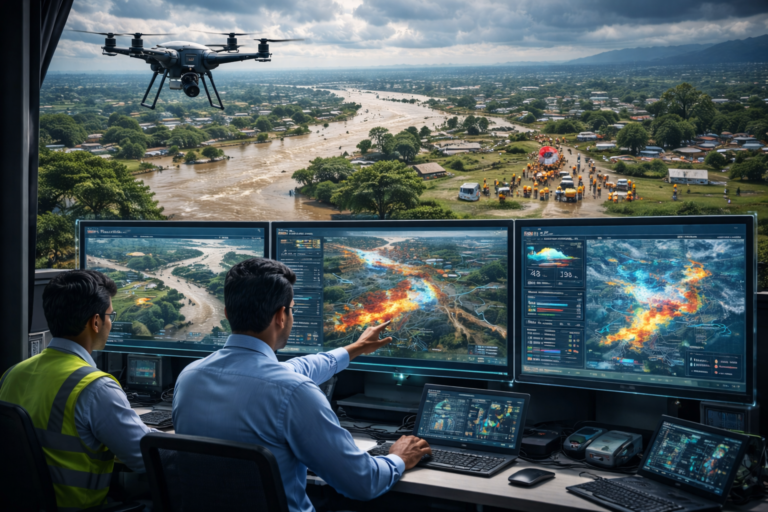
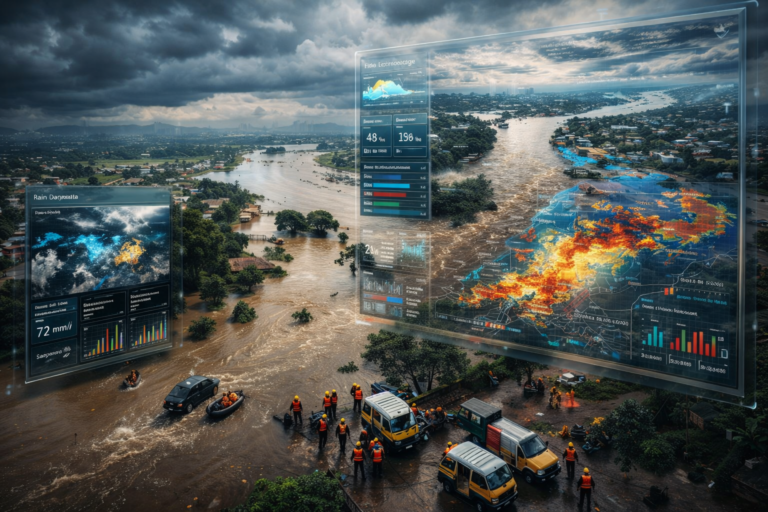
- Public Safety & Resilience: Real-time anomaly detection—ranging from fire identification to crowd management—enables emergency response times to accelerate by up to 35%.
- Environmental Stewardship: AI-driven sensors and vision systems manage waste, monitor air quality, and optimize energy consumption in public lighting and buildings.
Why the AI Camera is the Future of the Smart City
The “dumb” CCTV camera is becoming obsolete. In its place, the AI Edge Camera is emerging as the primary sensor for urban intelligence. Various research highlights that the future of surveillance lies in Edge AI, where data is processed locally on the device rather than transmitted to a distant server.
Decentralized Intelligence (Edge AI)
Traditional cameras are “data pipes” that clog networks. Gujar’s framework for Data Optimization Using Edge AI demonstrates that processing at the source minimizes redundant data and ensures privacy. By executing machine learning models directly on hardware (like NVIDIA Jetson or Google Edge TPU), cameras can identify a vehicle plate or a fire hazard and only transmit “decision packets” instead of raw video.
The “Appization” of Hardware
“The future belongs to those who see possibilities before they become obvious. We are moving toward an ‘App-centric’ hardware model where a camera’s function can be changed as easily as a smartphone app.” — IndoAI Technologies
This “Appization” allows a single camera to perform multiple roles – Vision Intelligence:
- Public Safety: Detection of 19+ traffic violations (e.g., triple riding, mobile use while driving).
- Urban Health: Systems like Tokyo’s “Plant Doctor” use vision models (YOLOv8) to monitor tree health.
- Retail Analytics: Tracking customer movement and heat-mapping in real-time.
A breakthrough concept is the Appization of AI Cameras. Much like a smartphone, the future AI camera is a modular platform. A single device can be “updated” with different “Apps” to serve various functions:
- Morning: Traffic flow monitoring and illegal parking detection.
- Afternoon: Retail analytics and heat-mapping in public plazas.
- Night: Women’s safety alerts and facial recognition for secure access.
Privacy by Design
As Ginni Rometty (Former CEO of IBM) famously stated: “Some people call this artificial intelligence, but the reality is this technology will enhance us. Instead of artificial intelligence, I think we’ll augment our intelligence.”
By utilizing Federated Learning and local processing, AI cameras address the “Big Brother” concern. Sensitive biometric data never leaves the device; only the insights (e.g., “Person detected in restricted zone”) are shared, making the system compliant with global privacy standards like GDPR.
Strategic Insights from IndoAI Research
Dr. Gujar’s papers (2024-2025) provide a roadmap for this disruption, focusing on the convergence of Disruptive Innovation Theory and Modular AI.
- Disruption of Incumbents: Gujar argues that AI-edge integration targets underserved markets—such as rural India or budget-constrained municipalities—with cost-effective, decentralized solutions that outperform high-end, complex legacy systems.
- Efficiency Gains: Case studies on IndoAI’s modular systems show a 40% reduction in latency and a 35% improvement in resource efficiency through decentralized architectures (Federated, Microservices and Serverless Edge AI).
- Hyper-Personalization: Beyond security, AI cameras are being utilized for “Hyper AI Personalization” in commercial zones, transforming how urban spaces interact with citizens by tailoring services to real-time behaviors.
Challenges and the Road Ahead
Hardware acceleration is critical, as high-performance GPUs can consume up to 250 watts.
“AI won’t replace humans, but those who use AI will replace those who don’t.” — Garry Kasparov, Former World Chess Champion
While the potential is vast, the transition to AI-powered cities faces critical hurdles:
- Data Heterogeneity: Managing diverse data types across different city departments.
- Ethical Vigilance: Addressing algorithmic bias, particularly in facial recognition, to ensure inclusive urban growth.
- Security: As devices become smarter, they become targets. Gujar emphasizes the need for Post-Quantum Cryptography (PQC) and Explainable AI (XAI) to build public trust.
Conclusion: The Leadership Imperative
For city planners and enterprise leaders, the message is clear: the future of the smart city is distributed, modular and vision-centric leading to perfect Vision Intelligence. Investing in AI camera infrastructure is not merely a security upgrade; it is the acquisition of a versatile, intelligent asset that can adapt to the evolving needs of the 21st-century citizen.
As Michael Flynn (Global Infrastructure Leader at Deloitte) emphasizes: “By leveraging data-driven insights, AI can revolutionize urban planning and resource management, from predicting trends to making cities more resilient.”
Ultimately, Vision Intelligence serves as the primary gateway to what Dr. Gujar describes as the “Cognitive City” or “Aware City”—an urban environment that doesn’t just react to problems, but anticipates them. The leadership mandate is clear: move the intelligence to the edge or be left behind in the data deluge.
Thus, the cities that successfully “appize” their infrastructure and move intelligence to the edge will be the ones that thrive in the coming decade of urban reinvention.
Selected References & Citations
- Gujar, V. (2024). Data Optimization Using Edge AI: A Framework for Efficient Real-Time Analytics – A Case Study of IndoAI AI Camera. International Journal of Science and Research (IJSR).
- Gujar, V. (2025). The Integration of Artificial Intelligence into Edge Camera Systems: A Perspective through Disruptive Innovation Theory. ResearchGate/IJIRT.
- Gujar, V. (2025). Smarter at the Edge: Evaluating Decentralized AI Deployment Models in Federated, Hierarchical, Microservices and Serverless edge AI Architectures. JSC Indoai.
- McKinsey Global Institute. (2024). Smart Cities: Digital solutions for a more livable future.
- Deloitte / ThoughtLab. (2025). AI-Powered Cities of the Future: Strategies for 250 Cities Globally.
- Gujar, V., & Rathore, A. K. (2024). AI Camera: Unique Technique to Hyper AI Personalization for Malls. IndoAI Case Study.
- https://www.pwc.com/gx/en/issues/c-suite-insights/ceo-survey.html