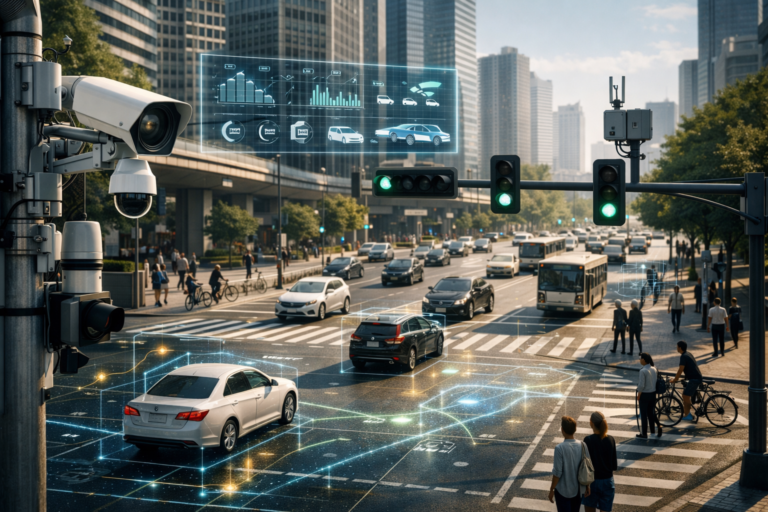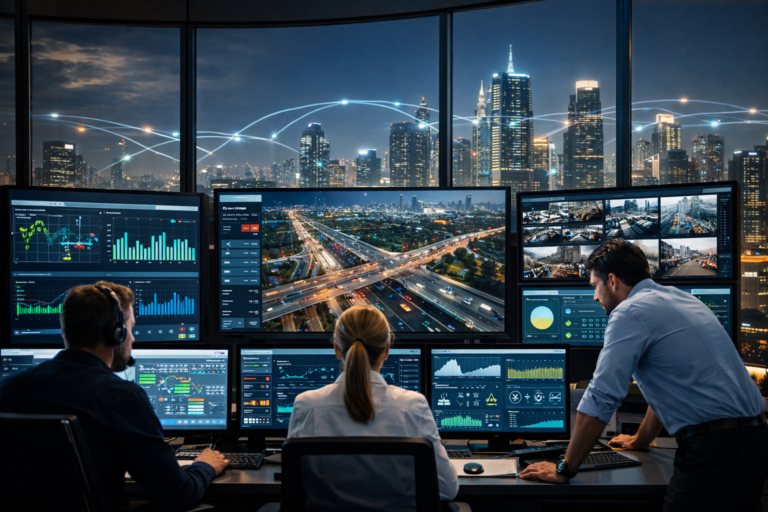

Why this matters (and why “on-prem” is the default in factories)
Factory safety is not a “poster problem”. It’s an operations problem: visibility, repeatability, and response time. Globally, the scale is sobering: ILO estimates cite 2.78 million worker deaths per year from work-related injuries and diseases, and large numbers of non-fatal injuries. A more recent peer-reviewed synthesis estimates 2.90 million work-related deaths in 2019.
In the US alone, employers reported 2.6 million injury and illness cases in private industry (2023). The National Safety Council estimated the cost of work-related fatalities and injuries at nearly $1.2 trillion (2022).
Factories choose on-prem CCTV AI for four practical reasons:
- Latency and reliability: safety interventions are second-level decisions, not “after upload”.
- Bandwidth economics: multiple HD streams to cloud is expensive and fragile outside top-tier connectivity.
- Data governance: video is sensitive personal data in many regimes; minimizing exposure helps compliance. (In India, DPDP Act 2023 is a major reference point for digital personal data processing. )
- Integration reality: factories already have cameras, NVR/VMS, and OT networks; on-prem AI sits inside that environment.
This playbook shows how to implement PPE compliance (helmet, vest, etc.) and forklift risk controls using on-prem video AI, with a focus on compliance evidence, operational SOPs, and measurable leading indicators.
Table of contents
1) Compliance framing: what safety teams are really audited on
India baseline (minimum)
Most plants still operate with a compliance mindset anchored in:
- Factories Act, 1948 and associated rules, including duties around worker health and safety, hazardous processes, and requirements like written health & safety policy (in model rules).
- OSHWC Code trajectory and state rules evolution. (Policy updates and employer action plans are being actively discussed; use your legal counsel for the latest applicability in your state.)
- ISO 45001 (common in export-linked manufacturing): leadership commitment, worker participation, hazard identification, operational control, incident investigation, continual improvement.
What auditors and corporate EHS actually want to see
Not “did you buy PPE AI”, but:
- Written policy and risk assessments tied to actual shopfloor hazards (ISO 45001 requires systematic OH&S management).
- Evidence of control effectiveness: trend lines, incident logs, near-miss learning, CAPA closure.
- Proof of separation controls in MHE zones (forklifts). OSHA’s guidance explicitly pushes separation and marked aisles where mechanical handling equipment is used.
On-prem CCTV AI becomes valuable when it produces audit-grade evidence: timestamped events, annotated clips, role-based response, and measurable reduction in repeat violations.
2) The operating model: safety outcomes you can actually “manage”
Think in three layers.
Layer A: Rules you enforce (non-negotiables)
- Helmet mandatory in defined zones
- Hi-vis vest mandatory in forklift corridors, loading docks
- No pedestrian entry into “forklift only” aisles
- Speed discipline and right-of-way at intersections
- No riding on forks / no passengers
Layer B: Leading indicators (you can reduce before injuries happen)
Near misses and unsafe acts dominate injury counts in most workplaces. A commonly cited safety pyramid relationship is 1 serious injury : 29 minor injuries : 300 near misses/unsafe acts (ratios vary, but the leading-indicator logic holds).
Layer C: Lagging indicators (what you report)
TRIR, LTIFR, severity rate, recordables, days away, and investigations.
Your CCTV AI program should be explicitly designed to lift Layer A compliance and crush Layer B near misses, so Layer C improves.
3) What “CCTV AI” should do in a factory (and what it must not pretend)
What it does well (today)
- Detect people, PPE items (helmet/vest), forklifts, pallet jacks, restricted-zone entry
- Track movement and compute proximity events
- Create near-miss events using surrogate safety metrics like Time-to-Collision (TTC) and Post-Encroachment Time (PET) (widely used in safety analytics).
- Provide continuous “non-fatiguing” monitoring across large halls (a key reason PPE compliance automation is researched heavily).
What it must not claim
- It cannot “guarantee” prevention. It reduces probability by improving detection and response time.
- It can be wrong in poor lighting, occlusion, unusual PPE colors/designs, or camera angles.
- It is not a replacement for physical controls (barriers, walkways) that regulators expect.
4) The on-prem architecture patterns that work in factories
Pattern 1: Edge AI box per site (most common)
- Existing cameras/NVR/VMS provide RTSP/ONVIF streams
- AI box ingests selected streams, runs models locally, stores short evidence clips
- Alerts go to supervisors, Andon lights/sirens, and the safety dashboard
This aligns with typical forklift and pedestrian separation enforcement expectations, because alerts must be local and immediate.
Pattern 2: Central on-prem server in plant data room
- Better for multi-line plants with many cameras
- Easier model management and retention
- Needs stronger network design and segmentation
Network hygiene (non-optional)
- Separate CCTV VLAN from corporate LAN where possible
- Whitelist only needed ports from VMS/NVR to AI box
- Local retention policies and access controls, especially if video is treated as personal data (DPDP Act reference point).
5) Camera audit checklist: safety analytics fails mostly because of optics
Before models, do a zone-by-zone camera audit:
- Forklift intersections: camera must see floor area where paths cross; avoid extreme top-down that hides forklifts under racks
- Loading docks: visibility of dock edge + trailer interface (forklift falls and crush incidents are a known fatal pattern per NIOSH).
- PPE zones: camera angle should show head and torso clearly; occlusion from machines is the enemy
- Lighting: backlight and glare kill accuracy; fix with WDR placement, not just “AI tuning”
- Privacy: avoid unnecessary coverage of break rooms and wash areas
Deliverable from audit: a camera-to-rule matrix
- Camera ID
- Zone covered
- Rules enforced
- Alert type and severity
- Owner and response SLA
6) Detection design: rules, thresholds, and “prompts” that safety teams can run
Below are practical rule definitions you can directly implement (or use as natural-language prompts if your system supports prompt-based configuration).
A) PPE: helmet and vest (high signal, high ROI)
Prompt examples
- “Alert when any person enters Zone A without a helmet for more than 2 seconds.”
- “Alert when any person in forklift corridor Zone F is missing a high-visibility vest.”
- “Count repeated helmet non-compliance by shift and contractor team.”
Implementation notes
- Use zone gating: enforce PPE only where needed. This reduces false alarms and worker friction.
- Add dwell time (2–5 seconds) so a person crossing frame edges does not spam alerts.
- Use contractor mode: contractors tend to drive variance; track by gate entry camera or badge integration if available.
Research on automating PPE compliance exists because large halls and worker count make manual enforcement hard.
B) Forklift safety: separation, speed discipline, intersections, blind spots
Forklift risk is unusually severe because the energy involved is high, and pedestrians are often in shared space.
Baseline incident scale (useful for leadership buy-in): OSHA estimates referenced in a hazard alert cite ~85 forklift fatalities and ~34,900 serious injuries annually, along with major costs.
Prompt examples
4. “Alert when a pedestrian enters Forklift-Only aisle (Zone M).”
5. “Alert when forklift and pedestrian are within 2 meters for more than 1 second in Zone X.”
6. “Alert when a forklift crosses intersection I without slowing (speed proxy via pixel velocity calibration).”
7. “Alert when forklift travels against the marked direction in aisle A3.”
8. “Create a near-miss event when PET < 1.0 seconds at intersections.”
Why PET/TTC matter
- TTC is a long-used crash-risk indicator that accounts for motion, not just distance.
- PET measures time gap between one actor leaving a conflict point and the other arriving; smaller is riskier, and it captures “near misses”.
C) Near-miss monitoring: convert “close calls” into a measurable control program
Define near-miss severity bands that match your layout:
- PET < 1.0s at key intersections: severe
- PET 1.0–2.0s: medium
- PET 2.0–3.0s: low
You are building a leading indicator engine that supports the safety pyramid logic: attack the base to prevent the top.
7) Alerting and response: the part that decides ROI
Use a three-tier severity model
- Red: immediate hazard, trigger siren/andon light + supervisor call + auto-clip saved
- Amber: supervisor push notification + clip + daily review queue
- Blue: analytics only (trend, training)
Evidence chain (audit-grade)
Every event should produce:
- 10–20 sec clip (pre and post)
- Zone overlay + reason code (no helmet, pedestrian breach, near miss PET)
- Who acknowledged and what action taken
- CAPA reference if repeated
This is exactly what ISO-style “operational control” and “continual improvement” programs look for.
8) Ten real-life incident examples (and how CCTV AI would have caught them)
Below are real incidents reported in safety literature and regulator summaries. Use these in your internal business case and in “toolbox talks”.
Example 1: Pedestrian crushed because forklift driver’s view was obstructed by the load
OSHA training library describes a case where a forklift carrying large rolls obstructed forward view and struck a pedestrian.
AI control: “Obstructed view risk” is hard, but AI can enforce pedestrian exclusion zones and alert on proximity in shared lanes.
Example 2: Pedestrian struck in a marked walkway (distracted driving / speeding)
OSHA accident detail (2019) describes a pedestrian hit in a walkway by a stand-up forklift, with hospitalization.
AI control: enforce low-speed zones, intersection slow-down, and pedestrian proximity alerts.
Example 3: Lumber mill worker fatally struck by forklift; earbuds policy not enforced
FACE report summary highlights a fatal struck-by case; distraction and enforcement gaps were noted.
AI control: “No-go pedestrian zone” near forklift travel pathways plus near-miss heatmap to identify hotspot redesign needs.
Example 4: Forklift overturn / crush patterns are common in fatal incidents
NIOSH Alert notes many fatalities occur when workers are crushed by overturns or falls from docks, and provides seven fatal incident narratives.
AI control: dock-edge zones, “no pedestrian behind reversing forklift” rules, and strict separation at docks.
Example 5: Kentucky pedestrian forklift fatalities show recurring unsafe behaviors
A hazard alert cites multiple pedestrian-related forklift deaths and provides practical separation advice.
AI control: enforce separation routes and create “behavioral reminders” using daily violation trends.
Example 6: OSHA recommends separating pedestrians and mechanical handling equipment aisles
OSHA eTool explicitly recommends walkways/railings/barriers and clear marking where mechanical handling equipment is used.
AI control: treat barrier breaches as red events, and quantify “barrier integrity” by repeated breaches.
Example 7: UK HSE position: separation is the most effective control
HSE guidance: separate pedestrian routes from vehicles wherever reasonable; design routes on “desire lines” so people actually use them.
AI control: prove that desire lines are being followed (or not) by generating path heatmaps and breach counts.
Example 8: Real plant adoption of edge AI for PPE and hazard monitoring (India context)
Economic Times reported Hindustan Coca-Cola Beverages using AI-enabled drones with edge AI to monitor PPE and hazards, supporting real-time alerts and fewer false alarms.
AI control: shows the feasibility of edge-first monitoring in industrial sites.
Example 9: Near-miss reduction case study (manufacturing)
A published case study page claims a Saudi manufacturing facility reduced forklift near misses by 62% in 3 months using video analytics.
AI control: use this cautiously as a vendor-claimed benchmark; but it illustrates the “measure near misses, then redesign” loop.
Example 10: PPE compliance monitoring is a recognized computer-vision application in industrial halls
Peer-reviewed work discusses the challenge of monitoring head-mounted PPE in large industrial spaces and evaluating CV approaches to automate compliance.
AI control: design helmet/vest detection with zone gating and dwell thresholds as described earlier.
9) KPIs and dashboards that executives understand
PPE dashboard
- Helmet compliance percentage by zone, shift, contractor
- Repeat offenders count (use carefully; focus on training and system fixes)
- Time-to-acknowledge and time-to-resolve
Forklift dashboard
- Near misses per 1,000 forklift hours (PET-based)
- Top 10 hotspots (intersections, dock edges)
- Pedestrian breach count into forklift-only aisles
- Intersection “slow-down compliance” rate
Business case language
When leadership asks “why invest”:
- Safety incidents have enormous direct and indirect cost; NSC estimate provides a credible macro anchor.
- Forklift incidents have known fatality and serious injury scale and recurring patterns.
- Near misses occur far more frequently than severe injuries; measuring them gives leverage.