India is witnessing a rapid expansion of AI-driven surveillance and identity automation across airports, corporate campuses, residential communities, and public infrastructure. With organisations under growing pressure to improve security, streamline workforce tracking, and comply with evolving data protection regulations such as the Digital Personal Data Protection (DPDP) Act, face recognition technology is increasingly being deployed directly through existing CCTV infrastructure.
Enterprises are no longer evaluating face recognition as a standalone feature but as an operational workflow that integrates attendance management, visitor access control, and security watchlist monitoring into a single system. Industry deployments across smart cities, logistics hubs, housing societies, and transportation infrastructure show that attendance verification and visitor management rely on nearly identical architectural decisions — including camera placement, capture quality, matching thresholds, liveness detection, audit trails, and retention controls.
This practical playbook explains how organisations in India are combining these workflows using face recognition on CCTV systems, highlighting real deployment patterns, compliance considerations, and operational best practices required to build scalable and defensible implementations.
Why Most Face Recognition CCTV Projects Fail
Most “face recognition for CCTV” projects fail for one predictable reason: organisations treat it as a feature rather than a workflow.
In reality, the same underlying technology supports two distinct operational use cases:
Attendance (presence + time rules)
Determines whether an employee was physically present at the entry point during a defined shift window.
Visitor Management (identity + access rules)
Determines whether a person should be allowed entry, flagged for verification, or routed through additional security procedures.
The most successful implementations treat these workflows as a unified system because nearly 80% of design decisions remain identical across both use cases.
Four Operational Truths About Face Recognition in Indian Deployments
1. Accuracy Is Context-Dependent
Vendor claims such as “99% accuracy” are incomplete unless evaluated against:
- 1:1 verification versus 1:N identification
- Accepted false match thresholds
- Image quality conditions such as lighting, blur, and camera angle
The National Institute of Standards and Technology (NIST) Face Recognition Vendor Test evaluates performance using explicit false positive identification rates (FPIR) and corresponding miss rates (FNIR), demonstrating that accuracy must always be measured against operational thresholds.
2. Attendance and Watchlists Solve Different Recognition Problems
Attendance typically uses 1:1 verification, where a claimed identity is confirmed.
Visitor monitoring and watchlists rely on 1:N identification, where a person must be matched against multiple enrolled identities. As watchlist size increases, false alert probability rises, making threshold tuning and SOP design critical.
3. Low-Light Performance Is Primarily a Camera Engineering Challenge
Recognition accuracy depends heavily on capture quality. Industry portrait-quality benchmarks commonly recommend inter-eye pixel distance guidance of approximately 90 pixels minimum and 120 pixels as best practice.
While CCTV rarely matches passport-quality imaging, these values serve as directional engineering benchmarks for focal length and mounting distance selection.
4. Anti-Spoofing Becomes Mandatory When Security or Payroll Depends on Results
Attendance fraud, proxy check-ins, and replay attacks are common in operational environments. The ISO 30107 standard defines Presentation Attack Detection (PAD) methodologies to detect spoofing attempts.
A Unified Reference Architecture for Attendance and Visitor Management
Step A: Define Identity Boundaries
Organisations must determine who the system recognises:
- Employees only (closed enrollment, easier)
- Known vendors and visitors (dynamic enrollment)
- Unknown walk-ins and watchlists (most complex)
Step B: Use One Pipeline With Dual Decision Modes
Common Processing Pipeline
- CCTV/NVR RTSP video ingest
- Face detection and tracking
- Image quality scoring
- Template generation
- Matching threshold evaluation
- Event logging and audit creation
- Retention and deletion enforcement
Attendance Mode: Typically 1:1 identity verification
Visitor Mode: Typically 1:N gallery comparison
Step C: Store Evidence Like an Auditor
Each event should include:
- Timestamp and location
- Match confidence score
- Face snapshot (short retention)
- Operator actions
- Decision reason codes
Attendance Implementation That Works in Real Operations
Camera Placement Using the Two-Gate Model
Most deployments perform best with:
- Entry capture checkpoint
- Exit capture checkpoint (optional but dispute-resistant)
Wide surveillance cameras should not be reused for attendance capture.
Enrollment Standards
Reliable deployments require:
- Multiple enrollment samples
- Automatic quality rejection
- Periodic re-enrollment for appearance changes
Attendance Logic Controls
Effective systems include:
- Cooldown windows preventing duplicate marking
- Tracking-based deduplication
- HRMS-controlled attendance policy enforcement
Low-Light Optimisation
Practical field improvements include:
- Controlled front lighting
- Reduced backlighting near glass entrances
- Stable capture distance
- Shutter adjustments for motion control
Anti-Spoofing for Attendance
Common threats include:
- Printed photo attacks
- Mobile replay attacks
- Collusion and proxy attendance
ISO 30107 PAD testing metrics such as APCER and BPCER help measure spoof resistance.
Visitor Management Using Face Recognition
Visitor recognition systems must focus on response workflows rather than identification alone.
Recommended Watchlist Segmentation
- Allow list
- Caution list
- Deny list
Alert Standard Operating Procedures
Alerts must define:
- Notification escalation paths
- Evidence visibility
- Allowed security actions
- Closure and documentation process
Thresholds Based on Operational Targets
Organisations should measure performance using:
- Acceptable daily false alert limits
- Miss rate tolerance for high-risk identities
Audit Trails as Compliance Evidence
Effective visitor FR deployments log:
- Identity confidence scores
- Security decisions
- Action ownership
- Retention compliance
Real-World Performance Challenges: Masks and PPE
NIST evaluations demonstrate measurable recognition degradation when masks or helmets are present. Facilities with PPE requirements should design alternate verification workflows at entry checkpoints.
DPDP Compliance Checklist for Face Recognition Deployments
Under India’s Digital Personal Data Protection Act, face recognition constitutes personal data processing and must follow:
- Purpose limitation
- Data minimisation
- Storage limitation
- Security safeguards
- User rights management
Minimum operational controls include:
- Clear signage
- Role-based access restrictions
- Audit logging
- Defined retention policies
Real Deployment Patterns Across India
Examples include:
- DigiYatra biometric airport boarding
- Housing society staff attendance automation
- Corporate campus entry verification
- Industrial facility gate authentication
- Hospital watchlist security systems
- Educational institution gate attendance models
Why Edge-First Architecture Is Increasing in India
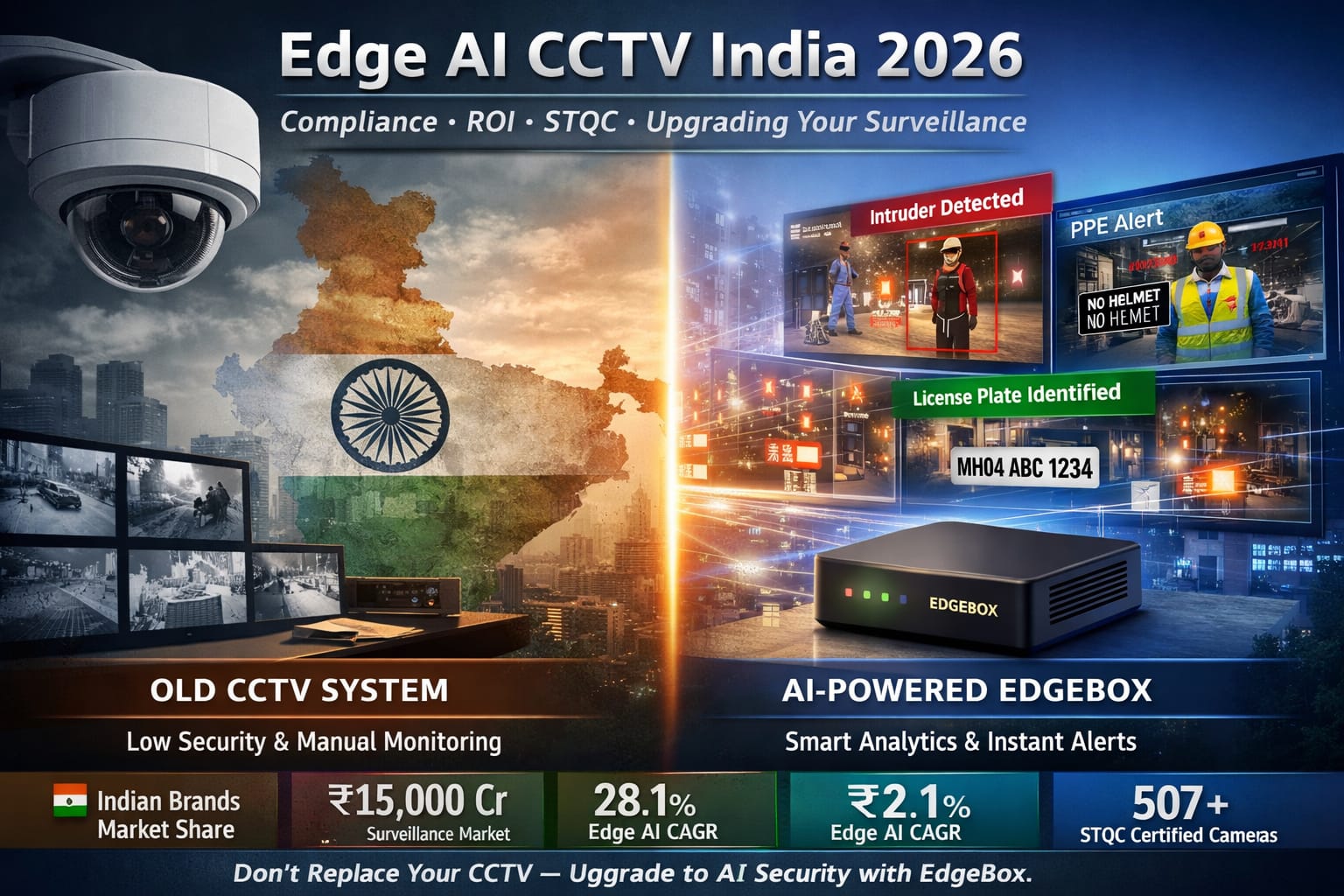
Unstable bandwidth and real-time identity requirements are driving adoption of local processing models. Edge AI platforms allow scalable deployments across heterogeneous CCTV infrastructure without heavy cloud dependency.
FAQs
It can be deployed, but you must treat it as personal data processing with clear purpose, notice/consent where required, retention limits, security safeguards, and grievance/erasure handling aligned to DPDP.
Ask for operational metrics: false matches per day per gate at your camera distance and lighting. Use pilot data to tune thresholds. NIST FRVT shows performance is always evaluated relative to false positive limits.
Yes, if you engineer capture: stable lighting, correct distance, and enough face pixels. Use portrait-quality pixel guidance as directional benchmarks for what “good” looks like.
Occlusion degrades performance; NIST has published dedicated evaluations on masks. Plan a fallback flow at the gate where policy allows safe removal or alternate verification.
If outcomes affect salary, access, or security, yes. Use PAD concepts aligned to ISO 30107; decide between passive liveness, active challenges (hard on CCTV), and human-in-loop for low confidence.
Keep the minimum needed for disputes and audits. DPDP emphasizes storage limitation and purpose limitation in the overall framework.