
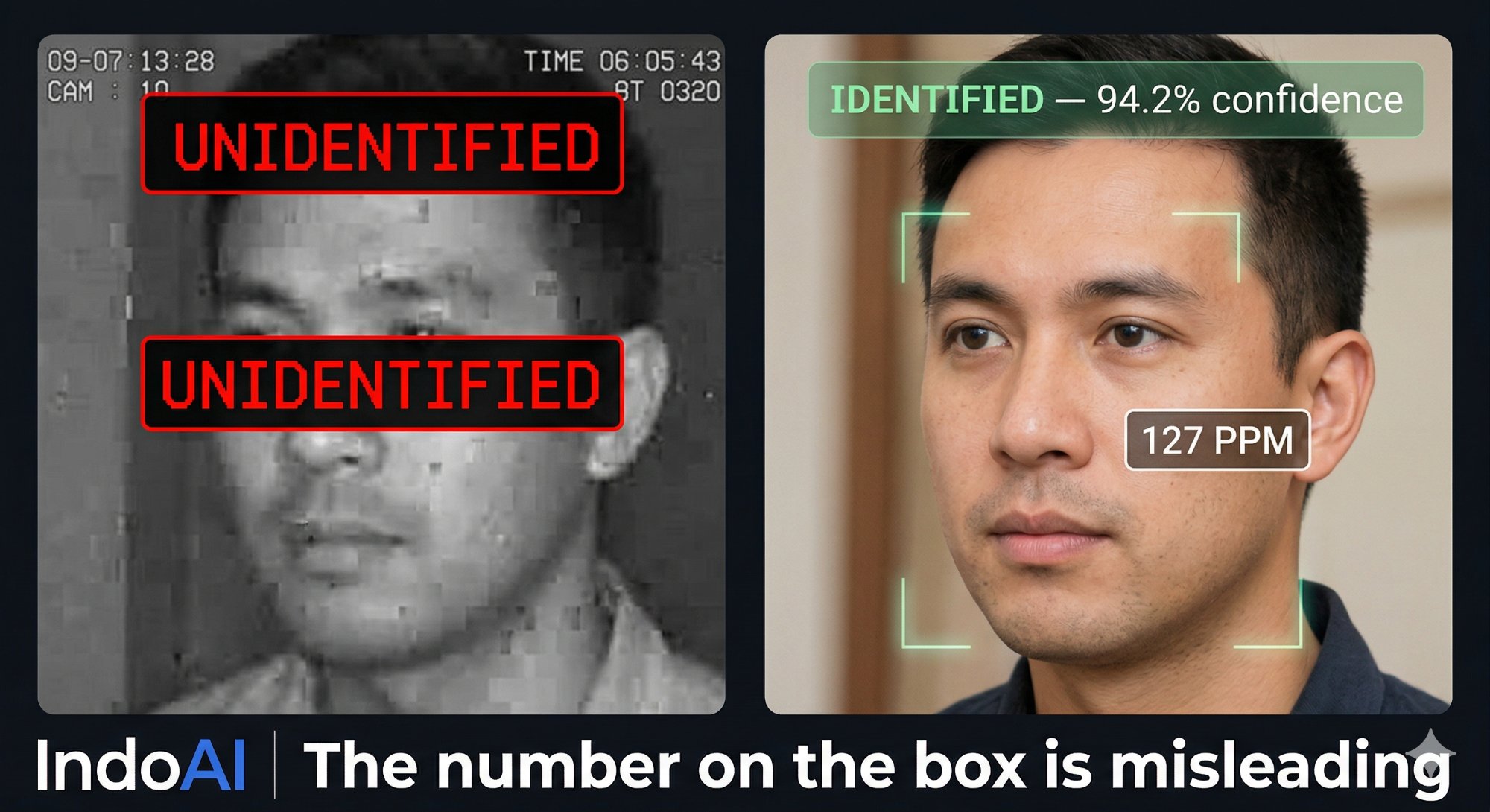
The Megapixel Myth: Why the Number on the Box Is Misleading
The surveillance industry has spent two decades marketing cameras by megapixel count. The implicit promise that more megapixels means better AI is not merely incomplete — it is actively harmful for AI analytics procurement.
Megapixels measure total sensor resolution: the count of photosites across the image sensor. An 8MP camera has approximately 8,000,000 pixels across its field of view. What it does not tell you is how many of those pixels land on the subject your AI model must analyse, at the distance you intend to deploy the camera.
Consider two cameras, both rated at 8MP:
Both cameras cost similarly. Both are 8MP. Camera B delivers 5.4× more pixel density on the target — the difference between 94% face identification accuracy and under 30%.
The correct metric is Pixels Per Metre (PPM) — how many horizontal image pixels correspond to one metre of real-world scene width at the target detection plane. PPM is never printed on camera spec sheets. It must be calculated from your camera datasheet, lens focal length, and deployment distance. This guide gives you everything you need.
Key Principle: Megapixels set the ceiling of what is possible. Focal length, deployment distance, and scene width determine how much of that resolution is concentrated on your target subject. PPM combines all three into a single actionable figure.
The PPM Standard: Minimum Requirements for Each AI Task
These benchmarks are derived from ETSI EN 62676-4, NIST FRVT data, and field validation from IndoAI deployments across Indian manufacturing, retail, banking, and infrastructure environments. They represent the minimum PPM for commercially acceptable accuracy — typically defined as >85% true positive rate at <1% false positive rate under representative conditions.
| AI Task | Min PPM | Recommended | Accuracy @ Min | Accuracy <50% Min | Notes |
|---|---|---|---|---|---|
| Face Identification | 80 PPM | 120–160 PPM | 87–91% | <40% | Match vs. database. Frontal required. |
| Face Detection | 20 PPM | 40–60 PPM | 90–95% | 55–65% | Presence only, no identity matching. |
| ANPR (Standard) | 40 PPM | 80–120 PPM | 88–92% | <50% | Measured on plate. BH series needs 80+ PPM. |
| ANPR (High Speed) | 80 PPM | 120 PPM | ~90% | <45% | Vehicles above 40 km/h. Shutter 1/1000s min. |
| Crowd Counting | 5 PPM | 8–12 PPM | 92–96% | ~80% | Density-map algorithms. Overhead mounting preferred. |
| People Counting (Line Cross) | 10 PPM | 20–30 PPM | 94–97% | ~75% | Head-top detection. Nadir angle required. |
| Fire & Smoke Detection | 10 PPM | 15–20 PPM | 90–94% | ~70% | Texture/colour model. Full scene coverage mandatory. |
| PPE Compliance | 15 PPM | 25–40 PPM | 86–90% | <55% | Helmet, vest, glove, boot. Body ≥80 px vertically. |
| Fall Detection | 10 PPM | 15–25 PPM | 88–92% | ~60% | Pose-estimation. Full body must be visible. |
| Vehicle Classification | 20 PPM | 35–50 PPM | 89–93% | ~65% | Car/truck/bus/bike. Side profile best. |
| Perimeter Intrusion | 8 PPM | 12–20 PPM | 92–96% | ~78% | Human presence. Wide field preferred. |
| Object Left Behind | 12 PPM | 20–30 PPM | 85–90% | ~55% | Static detection. Min object size 15cm. |
| Facial Attributes / Emotion | 120 PPM | 160+ PPM | 82–86% | <30% | Age, gender, emotion. Frontal, controlled lighting essential. |
Critical Field Note: These PPM values apply to the region of interest — the target object — not the full camera frame. A wide-angle camera covering a car park may deliver 5 PPM scene-level but only 2 PPM on a number plate at the far end. Always calculate PPM at the target object at the maximum deployment distance.
The Non-Linear Accuracy Cliff
Accuracy holds relatively stable down to ~70% of the minimum PPM, then drops sharply — because neural network feature extraction relies on spatial frequency information that is simply absent when pixel density falls below a critical level. The model does not just become less accurate; it begins making structurally unsound inferences.
The Resolution–Distance–FoV Calculation Formula
Every camera placement decision should begin with a calculation. The three-step formula chain below derives the PPM your camera delivers at any deployment distance, using only figures from the camera and lens datasheet.
Sensor Width Reference: 1/4" = 3.6mm · 1/3" = 4.8mm · 1/2.8" = 5.37mm · 1/2.7" = 5.6mm · 1/2" = 6.4mm · 1/1.8" = 7.18mm · 1/1.2" = 8.8mm · 1" = 12.8mm
Worked Examples


Sensor Size and Its Impact on AI Accuracy in Low Light
Two cameras can share identical megapixel counts and AI chipsets yet perform radically differently below 20 lux. The reason is pixel pitch: the physical area of each photosite. Larger pixels collect more photons per exposure, producing better SNR and fewer noise patterns that AI feature extractors misinterpret as genuine scene content.
The 1/1.8" sensor has 72% more photosite area — ~2.98× more photons per pixel, ~5× higher full-well electron capacity, and ~10 dB better SNR at 5 lux. That 10 dB gap is the boundary between functional and non-functional AI inference at night.
Procurement Rule: For any deployment where illumination drops below 20 lux at any point in the 24-hour cycle — parking lots, perimeters, warehouse aisles, corridors — specify a minimum 1/1.8" sensor. The 25–40% camera cost premium is recovered immediately in avoided accuracy failures and re-installation costs.
Compression Artifacts and Their Effect on AI Model Accuracy
Every production deployment encodes output in H.264, H.265, or H.266. Compression artifacts are one of the least-discussed causes of AI analytics failure. The damage mechanism is not obvious: compression does not simply blur the image. It introduces structured artifacts that AI models misinterpret as genuine scene features, causing both false positives and false negatives that no amount of repositioning will fix.
H.264 vs H.265 Artifact Architecture
H.264 uses fixed 8×8 pixel DCT macroblocks. At low bitrates, hard edges appear at 8-pixel intervals regardless of scene content. A face recognition model looking for facial gradients encounters a grid of artificial 8-pixel-spaced edges, extracting incorrect feature vectors. H.265 uses variable CTUs (4×4 to 64×64 pixels) allocated adaptively — high-detail areas get smaller CTUs, preserving AI-critical features at 40–50% lower bitrate than H.264.
Quantified Impact on AI Model Performance
| Codec & Bitrate (4MP Camera) | Face ID | ANPR | PPE Detection | Crowd Count Error | Recommendation |
|---|---|---|---|---|---|
| Raw (No Compression) | ✓97% | ✓99% | ✓95% | <2% | Baseline — impractical |
| H.265 @ 4+ Mbps | ✓95% | ✓97% | ✓93% | <3% | Recommended standard |
| H.265 @ 1.5–4 Mbps | ✓91% | ✓94% | ✓89% | <5% | Acceptable for most AI tasks |
| H.265 @ <1.5 Mbps | ✗78% | 82% | 74% | 8–12% | Marginal — avoid for identification |
| H.264 @ 4+ Mbps | ✓91% | ✓93% | ✓88% | <4% | Acceptable if H.265 unavailable |
| H.264 @ 2–4 Mbps | 84% | 87% | 81% | 6% | Marginal for face identification |
| H.264 @ <1.5 Mbps | ✗63% | ✗71% | ✗58% | 15–22% | Unacceptable for AI analytics |
| H.264 @ 500 kbps | ✗38% | ✗44% | ✗31% | 30%+ | Effectively non-functional |
Hidden Budget Risk: A 50% bitrate cut from 4 Mbps to 2 Mbps in H.264 reduces face identification from 91% to 84% — a drop visible only during acceptance testing or, worse, during an incident when footage is non-actionable. Set minimum bitrate floors contractually and verify with AI accuracy benchmarks, not visual inspection.
Minimum Bitrate by AI Task
Face Identification
Minimum 3 Mbps H.264 / 1.5 Mbps H.265 — non-negotiable for database matching
ANPR (Standard Speed)
Minimum 2 Mbps H.264 / 1.2 Mbps H.265
PPE & Behaviour Analytics
Minimum 2 Mbps H.264 / 1 Mbps H.265
People Counting / Crowd
Minimum 1 Mbps H.264 / 600 kbps H.265
Fire & Smoke / Perimeter
Minimum 800 kbps H.264 / 500 kbps H.265
Interactive Camera Placement Calculator
Enter your camera and deployment parameters. The calculator determines PPM, scene width, horizontal FoV, and pass/fail status against all 13 AI task minimums simultaneously.
| AI Task | Min PPM | Your PPM | Status |
|---|
Save Your Results: Use Ctrl+P / Cmd+P to print or save as PDF for your project specification document. IndoAI field engineers validate these calculations during pre-installation site surveys — contact us at indo.ai.
How IndoAI’s Edge Platform Bridges the Resolution Gap
The resolution, sensor, and compression challenges in this guide apply to camera hardware. IndoAI’s contribution is in the inference layer — how frames are consumed by AI models after leaving the camera. This is where the real-world accuracy gap is recovered without requiring camera replacement.
The critical step is ROI cropping at full sensor resolution. Most VMS platforms downsample the entire frame to the AI model’s input dimensions, discarding the high-resolution pixel data the camera captured. IndoAI’s pipeline crops the specific region containing the target object at native sensor resolution before passing it to the AI model — preserving all available PPM for inference.
Every AI model deployed through IndoAI’s Appization marketplace is profiled with minimum PPM requirements, minimum bitrate requirements, and minimum sensor size recommendations. The platform’s compatibility layer verifies that connected cameras meet these requirements before activating inference — preventing silent accuracy degradation in production.
Explore Appization AI App Store for Edge Cameras →Frequently Asked Questions
Fifteen questions answered in technical depth for system integrators, architects, and procurement teams.
What is pixels-per-metre (PPM) and why does it matter more than megapixels?+
Pixels-per-metre (PPM) measures how many image pixels correspond to one metre of real-world scene width at the target detection distance. A camera rated at 8MP may deliver only 18 PPM at 20 metres with a wide-angle lens — far below the 40 PPM minimum needed for ANPR. Megapixels measure total sensor resolution; PPM measures how that resolution is concentrated at the specific zone your AI model must analyse.
The distinction matters because AI models require a minimum number of pixels on their target object to extract usable features. When PPM falls below the task minimum, feature extraction degrades in a sharp, non-linear drop — not a gradual decline — because the model begins making structurally unsound inferences rather than merely imprecise ones.
A 2MP camera on a tight, purposefully positioned lens can outperform an 8MP wide-angle camera for facial identification because it concentrates its pixels on the target zone. Megapixels set the ceiling; PPM determines what is actually delivered in the specific deployment geometry.
What PPM is required for facial recognition to work reliably?+
The industry minimum for face identification — matching a face against a stored database — is 80 PPM. NIST FRVT benchmark data shows leading algorithms begin achieving above 85% true positive rate at ~80 PPM under controlled conditions, rising to 94–97% at 120–160 PPM.
For face detection only (confirming presence, without identity matching), the threshold drops to 20 PPM. Detection models use coarser features — oval shape, skin-hair contrast, bilateral symmetry — that are discernible at lower resolution.
Critical caveats: these figures assume frontal face presentation (within ±30° of camera axis), adequate illumination (above 50 lux at the face), and H.265 encoding above 1.5 Mbps. For Indian deployments, specify AI models validated on diverse South Asian demographic datasets or request validation data from the AI vendor specifically for your deployment population.
How do I calculate the PPM a camera will deliver at a given distance?+
Three datasheet inputs: horizontal pixel count (e.g. 2688 for 4MP), sensor width in mm (e.g. 5.37mm for 1/2.8"), and focal length in mm (e.g. 4mm). Plus your deployment variable: target distance in metres.
Step 1 — Scene Width (m): = (Sensor Width mm × Distance m) / Focal Length mm. Example: (5.37 × 5) / 4 = 6.71m scene width at 5 metres.
Step 2 — PPM: = Horizontal Pixel Count / Scene Width. Example: 2688 / 6.71 = 401 PPM.
For varifocal lenses, use the minimum focal length (widest view, worst-case PPM) as your design baseline. For ANPR, separately verify the pixel count on the plate: if PPM = 401 and plate width = 0.5m, the plate occupies 200 pixels — adequate for ANPR. Use IndoAI’s embedded calculator in Section 06 to automate this calculation and simultaneously check all 13 AI task minimums.
Why does sensor size matter if the megapixel count is the same?+
Sensor size determines pixel pitch — the physical area of each photosite. A 1/1.8" sensor with 4MP has a pixel pitch of ~3.45 µm, while a 1/2.8" sensor with 4MP delivers only 2.0 µm — meaning 2.98× fewer photons collected per pixel per unit of exposure time.
This translates into three AI-critical metrics: (1) Full-well electron capacity — larger pixels hold more charge before saturating. (2) Signal-to-noise ratio — at 5 lux, 1/1.8" operates at ~52 dB SNR vs ~38–42 dB for 1/2.8" — a 10+ dB difference that is enormous for AI feature extraction. (3) Noise floor — random per-pixel luminance variation that AI models interpret as false texture features is dramatically lower on larger-pixel sensors.
At 5 lux, the 1/1.8" sensor sustains face identification at ~91% while the 1/2.8" sensor at identical megapixels and lens drops to ~72%. The 25–40% camera hardware premium is recovered in avoided accuracy failures and service calls for any 24/7 deployment with low ambient light periods.
How do H.264 and H.265 compression artifacts affect AI model accuracy?+
H.264 uses a fixed 8×8 pixel DCT macroblock grid. At low bitrates, hard edges appear at 8-pixel intervals regardless of scene content. A face recognition model looking for facial texture gradients encounters a grid of artificial 8-pixel-spaced edges overlaid across every face, causing it to extract incorrect feature vectors that fail to match the stored template.
H.265 uses variable CTUs (4×4 to 64×64 pixels) allocated adaptively. High-detail regions receive smaller CTUs preserving AI-critical features; homogeneous areas receive large CTUs for efficiency. H.265 artifacts manifest as gradual texture blurring — far less damaging than H.264’s hard block edges. H.265 achieves equivalent AI model accuracy at approximately 40–50% lower bitrate.
Practical consequence: an ANPR model achieving 99% on raw frames may drop to 78% on H.264 footage at 500 kbps, and to 91% on H.265 at the same bitrate. Specify minimum bitrate floors contractually and verify with AI accuracy benchmarks, not visual inspection, in acceptance testing.
What is the minimum camera resolution for ANPR on Indian number plates?+
ANPR for standard Indian plates requires a minimum of 40 PPM on the plate itself, with 80 PPM recommended. At 40 PPM a 500mm plate occupies 20 pixels — the absolute minimum for character segmentation. At 80 PPM the plate occupies 40 pixels, enabling reliable reads of all standard formats including BH-series and state-code Devanagari characters.
Indian-specific complications: at least eight distinct plate formats are in active circulation (old white/yellow, HSRP, BH series, commercial, government, defence) with varying fonts and reflective properties. Your ANPR model must be validated on all formats present in your deployment geography. For states with Devanagari or other Indic script in the state code, 80 PPM is the practical minimum for the script region.
Camera specification: use a narrow focal length lens (12–25mm for 4–12m capture range). Specify minimum shutter speed of 1/500s for vehicles above 20 km/h and 1/1000s for highways. Use dedicated 850nm IR illumination for night operation. Lock varifocal lenses post-calibration.
Can a fisheye or wide-angle camera be used for AI analytics?+
Yes, but only for AI tasks with low PPM requirements — crowd counting, occupancy monitoring, queue length estimation, general motion detection. A fisheye covering 180° delivers approximately 40–50 PPM at the image centre and as little as 8–12 PPM near the periphery — adequate for crowd counting (5 PPM) but wholly insufficient for face detection (20 PPM) or PPE compliance (15 PPM).
Barrel distortion in wide-angle lenses (2.8mm and below) additionally reduces AI accuracy: at 10%+ distortion, face recognition accuracy can fall 20–35% versus a rectilinear lens at equivalent PPM, because the model was trained on undistorted geometry. Best practice: use fisheye for overview and occupancy analytics; specify purpose-built narrow-FOV cameras for any identification or attribute detection task.
How does frame rate affect AI detection accuracy?+
Frame rate affects AI detection through two independent mechanisms: temporal sampling density and motion blur, each requiring separate specification.
Temporal sampling: At 15 fps, a person walking at 1.5 m/s moves 10 cm between frames — acceptable for counting but marginal for gait analysis. At 10 fps, a vehicle at 20 km/h moves 55 cm between frames, creating discontinuities that tracking algorithms must bridge with prediction rather than observation, increasing error rates.
Motion blur: At 1/30s shutter, a vehicle at 30 km/h blurs approximately 28 cm of scene width. At an ANPR distance of 10m with 400 PPM, this is 112 pixels of blur — no ANPR model can read a plate with that level of motion blur. Shutter speed and frame rate are independent settings. For ANPR at 30+ km/h: 1/500s minimum shutter. For most analytics: 15–25 fps is optimal.
What is the optimal camera height for people-counting AI?+
People-counting AI achieves highest accuracy at 3 to 5 metres height with a nadir (straight-down) or near-nadir angle (within 20° of vertical). At this height, each person’s head presents as a small, well-separated ellipse against the floor — the ideal input for density-map and blob-detection counting algorithms.
Below 2.5 metres: taller individuals occlude shorter ones, causing systematic undercounting of 8–20% in bidirectional flows. Above 6 metres: the target head-top becomes very small; motion cues diminish; tracking algorithms experience higher ID-switch rates. For corridors wider than 5 metres, use two overlapping cameras in a stereo counting configuration with virtual zone fusion in the VMS software.
How does IR illumination distance affect AI accuracy at night?+
A camera marketed as “30-metre IR range” specifies the distance at which a human observer can see a scene — not where the camera maintains sufficient SNR for AI feature extraction. For AI-grade illumination on a 1/2.8" sensor, effective range is typically 50–60% of the stated figure: “30-metre IR” practically delivers AI-adequate illumination to approximately 15–18 metres.
850nm IR illuminators are more efficient for silicon sensors than 940nm covert IR, which reduces effective range by 25–35%. For perimeter security or ANPR at ranges above 20 metres in darkness, specify dedicated external IR illuminators with rated effective range of 1.5–2× your maximum target distance. For face identification at night: most AI models were trained on visible-light data and perform poorly on IR imagery. Either use white-light LED supplemental illumination or ensure your model is specifically validated on near-IR imagery — IndoAI’s Appization platform includes IR-aware model variants for key detection tasks.
What resolution is recommended for fire and smoke detection AI?+
Fire and smoke detection AI operates on texture anomalies, colour signatures, and temporal motion patterns — not geometrically defined objects. PPM requirements are therefore lower: 10 PPM is the practical minimum. However, other factors matter more than resolution for fire detection accuracy.
Coverage: A 5 PPM camera covering the full hazard zone is more effective than a 40 PPM camera covering 30% of it. Prioritise full-zone coverage over resolution. Frame rate: 15 fps minimum is needed for temporal change-detection to function correctly. Model training match: Validate that your AI model was trained on fire types representative of your environment — warehouse fire, chemical fire, electrical fire, and cooking environments all have distinct visual signatures. Thermal integration: For early smouldering detection (3–15 minutes before visible smoke), a radiometric LWIR thermal camera alongside visible AI provides far earlier detection than any resolution improvement.
How does lens distortion affect AI model accuracy?+
Barrel distortion (wide-angle lenses) and pincushion distortion (telephoto lenses) alter the apparent shape, proportion, and relative positions of objects. AI models trained on rectilinear images encounter distorted footage as a distribution shift — the spatial relationships between features they have learned are geometrically modified.
At 3% barrel distortion (typical in 6mm+ lenses), face recognition accuracy falls approximately 4–8%. At 10% distortion (typical 2.8mm lenses), accuracy drops 15–25% for identification tasks. At 20%+ (fisheye), accuracy falls 30–40% for identification.
Mitigation: (1) Specify lenses with <5% barrel distortion for identification-class AI tasks. (2) IndoAI’s Edge Box applies digital de-warping using per-camera lens calibration before inference, recovering 70–85% of the accuracy loss from barrel distortion. (3) Fine-tuning the AI model on distorted imagery from the specific lens eliminates the distribution shift entirely.
What is the difference between camera resolution and AI model input resolution?+
Camera resolution is the native sensor output — e.g. 2688×1520 for 4MP. AI model input resolution is the fixed image dimensions the neural network was compiled to accept — typically 416×416, 640×640, or 1280×720. When a full 4MP frame feeds into a 640×640 model, the system downsamples — discarding 76% of horizontal pixels. An 8MP camera (3840 pixels wide) feeding a 640×640 model effectively operates as a sub-1MP camera for AI inference. The high-resolution sensor you paid for is completely wasted.
The correct approach — implemented in IndoAI’s Appization inference pipeline — is to run inference on crops of the full-resolution frame at the AI model’s native input size. The system crops the region of interest at native sensor resolution and resizes only that crop to the model input dimensions, preserving all available PPM for the target object. When evaluating AI analytics systems, ask explicitly: “Does inference run on downsampled full-frame video, or on full-resolution crops?”
How do I evaluate whether a camera meets PPM requirements before purchasing?+
Complete this four-step process before purchase, before site survey, and before any tender is closed.
Step 1 — Datasheet values: Extract horizontal resolution (pixels), sensor size (1/X" format, convert to mm from the reference table in Section 04), and lens focal length in mm. For varifocal lenses, use the minimum focal length (worst-case PPM).
Step 2 — Apply the formula: Scene Width = (Sensor Width mm × Distance m) / Focal Length mm. PPM = Horizontal Pixels / Scene Width. Use IndoAI’s embedded calculator in Section 06 for rapid calculation and multi-task comparison.
Step 3 — Cross-reference task minimums: Compare calculated PPM against the minimum from the Section 02 table. Target at least 1.5× the minimum as your design baseline, to provide margin for mounting angle tolerance (±10°) and lens focal length tolerance (±5%).
Step 4 — Verify supporting constraints: (a) Minimum illumination ≤ worst-case ambient light level. (b) NVR/VMS can sustain AI-grade bitrate for all AI-designated cameras simultaneously. (c) Lens distortion <5% for identification tasks. (d) Frame rate and shutter speed appropriate for subject motion speed. For complex deployments, request an IndoAI pre-installation site survey.
What role does IndoAI’s Edge Box play in resolving resolution and compression trade-offs?+
IndoAI’s Edge Box sits between existing IP cameras and the network, intercepting the H.264 or H.265 stream and running AI inference locally. It resolves four primary challenges from this guide simultaneously.
Downsampling problem: The inference pipeline crops regions of interest from the full-resolution decoded frame, ensuring native camera PPM is available for inference rather than being discarded by full-frame downsampling. An existing 4MP camera at borderline PPM can achieve acceptable AI accuracy through this pipeline when the same camera feeding a conventional NVR’s AI engine fails.
Compression artifacts: The Edge Box decodes the compressed stream to raw pixels before inference. Pre-processing (denoising, contrast normalisation) further mitigates coding artifact patterns that AI models would otherwise misinterpret as genuine image features.
Lens distortion: Configurable de-warp profiles using per-camera lens calibration data correct barrel and pincushion distortion before inference — valuable for 2.8mm and 4mm wide-angle deployments.
Legacy infrastructure: The Edge Box enables AI analytics on the installed camera base without hardware replacement, reducing deployment cost by 40–60% versus camera-replacement approaches. Appization AI models are deployed via over-the-air updates, allowing the AI layer to be upgraded independently of camera hardware. Explore at https://indo.ai/content/appization-ai-innovation-part-1.html.