
IndoAI vs Spot AI comes down to where the AI runs. Both retrofit existing CCTV and keep full-resolution video on site. Spot AI pairs an on-site recorder with a cloud layer for agent building and reasoning. IndoAI runs inference on the edge in India, under Indian data residency, and licences models per camera through Appization.
Most video AI comparisons stop at feature checklists. That is the least useful part of the decision. Two platforms can both claim object detection, PPE compliance, intrusion alerts and license plate reading, and still produce completely different outcomes in an Indian deployment, because the things that actually diverge are architectural and regulatory: where the model runs, who holds the video, whose jurisdiction the recording sits in, and who answers the phone at 3am on a Tuesday in Pune.
This piece compares the two honestly. Spot AI is a well built, well funded platform with real strengths, and there are buyers for whom it is the correct answer. It is also a US company designed for a US market, and that shapes everything from the contract currency to the compliance posture. If you are procuring for an Indian site in 2026, those are the differences worth a hard look.
| Dimension | IndoAI | Spot AI |
|---|---|---|
| Company base | Pune, India. Founded 2021. | San Francisco Bay Area, USA. Founded 2018 by three Stanford friends, Tanuj Thapliyal, Rish Gupta and Sud Bhatija. |
| Core model | Programmable AI camera platform. Models run at the edge, on-camera or on an on-site EdgeBox. | AI Camera System. An on-site Intelligent Video Recorder (IVR) paired with a cloud console and cloud-side AI agents. |
| Works with existing CCTV | Yes. Any ONVIF or RTSP IP camera, any brand, plus IndoAI cameras. | Yes. Existing IP cameras across roughly 100 brands, and legacy analog through the IVR. |
| Where inference runs | On the edge, inside the premises. No round trip required. | Local recording and processing on the IVR, with agent creation and higher-level reasoning cloud-side. |
| Full-resolution video | Stays on site by default. | Stays in the facility on the IVR, with metadata sent to the cloud. |
| India data residency | Yes, Indian hosting for anything that leaves the site. | No published India residency commitment. Ask for it in writing. |
| Custom capability | Appization model marketplace, plus model onboarding for partners and developers. | Iris, a no-code conversational agent builder launched in April 2025. |
| Commercial | INR contracting, GST invoice, India support hours. | Quote-based USD subscription per camera. No public list price. |
| Public scale claim | Indian deployments across manufacturing, retail, campuses and civic sites. | Over 1,000 enterprise deployments, largely North American. Has raised 93 million dollars. |
Read that table twice. Four rows are close to identical, which is the honest starting point: both platforms retrofit cameras you already own, and both keep full-resolution video on site. Anyone telling you Spot AI is a pure cloud product that ships your video offshore is misrepresenting it. The differences that matter are narrower and sharper than the marketing on either side suggests.
Spot AI sells what it calls an AI Camera System. The physical anchor is the IVR (Intelligent Video Recorder), an on-site appliance that connects to existing IP cameras and, for older sites, analog cameras. The IVR records locally, so full-resolution footage stays in the building, and one IVR can consolidate several older recorders. On top of that sits a cloud console for viewing, search, sharing and incident management.
The interesting part is the AI layer. In late 2024 Spot AI shipped prebuilt Video AI Agents for safety, security and operations. In April 2025, at Google Cloud Next, it launched Iris, pitched as a no-code conversational builder for custom video agents. The workflow is genuinely slick: describe what you want detected in plain language, supply roughly twenty labelled example images, and you have a running agent in minutes rather than the multi-week annotation and training cycle a custom model usually demands. Spot AI positions this as hardware independent, working against almost any RTSP stream.
Credit where it is due. That is a real product advance, and it is the single strongest thing Spot AI has. The company also holds SOC 2 Type II and operates HIPAA-aligned infrastructure, which matters to US healthcare and enterprise buyers, and it has the funding and headcount to keep shipping.
Spot AI's weakness in an Indian deployment is not the technology. It is the jurisdiction and the go-to-market. There is no published Indian entity, no INR price list, no stated India data-residency commitment, and support runs on US hours. For a Bay Area manufacturer with sites in Texas and Ohio, none of that is a problem. For a Pune plant answering to an Indian compliance officer, all of it is.
IndoAI is a programmable AI camera platform built in India, founded in Pune in 2021. The framing we use internally is a two-layer model. Hardware OEMs such as Hikvision, Axis, CP Plus and Hanwha own the capture layer, and they are good at it. IndoAI is the open intelligence layer that sits on top of whatever they have already sold you. We are not trying to replace your cameras, and we do not compete with the people who make them.
Practically, that means three things. First, an EdgeBox or an IndoAI camera runs the models on site, so detection happens where the video already is. Second, Appization lets you install, swap and licence individual AI models per camera the way you install apps on a phone, drawing on a catalogue of more than sixty five models covering ANPR, PPE, fire and smoke, intrusion, footfall, queue length, vehicle classification and more. Third, everything that does leave the site stays on Indian infrastructure.
The design intent is narrow and deliberate: an Indian buyer should be able to keep the cameras they own, add exactly the intelligence they need, change their mind next quarter, and never have to explain to a regulator where the footage went.
This is the fork in the road. Both platforms keep recorded video on site. They differ in where the thinking happens.
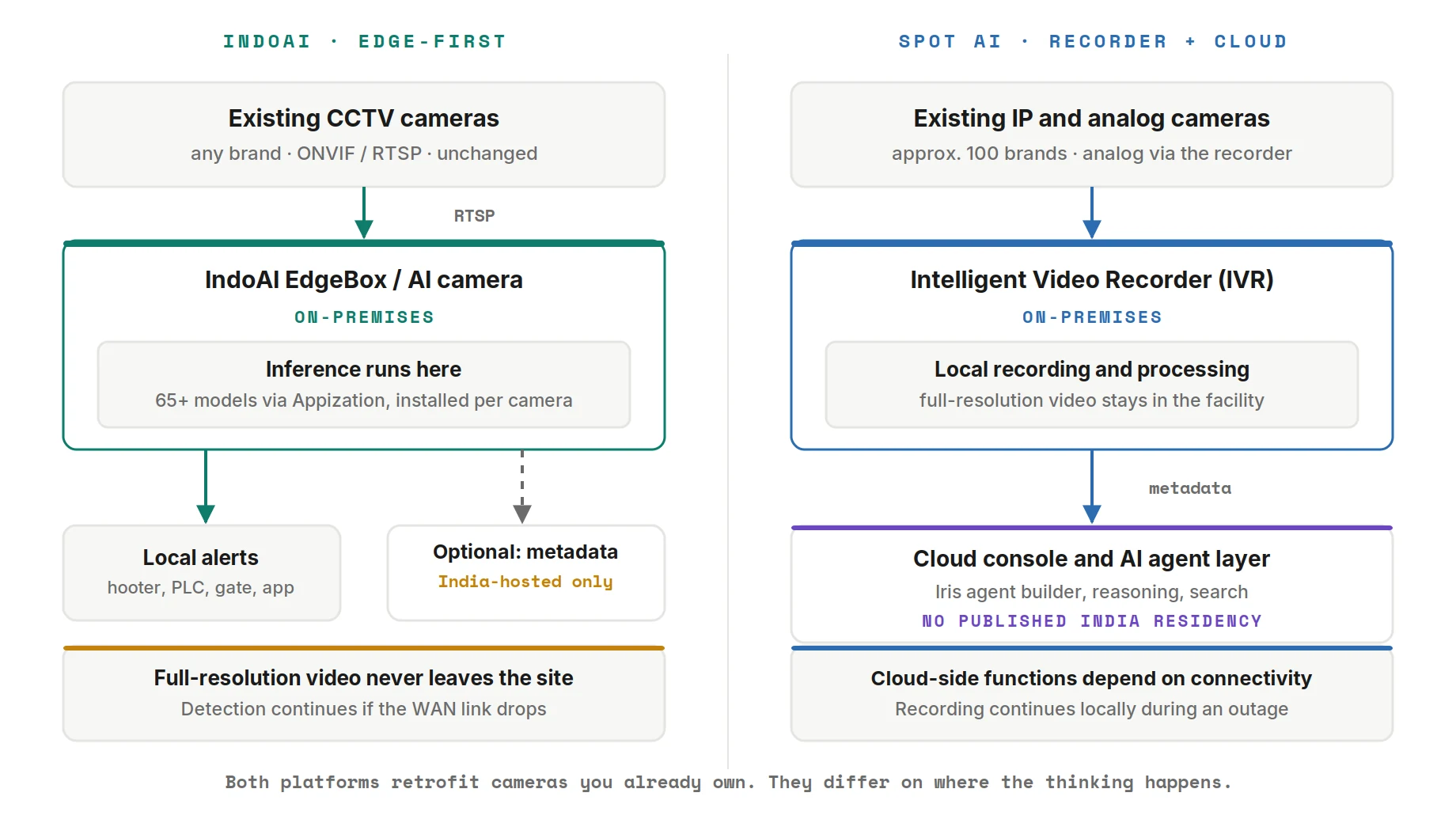
On the IndoAI side, the model executes on the EdgeBox or the camera itself. A PPE violation is detected, classified and alerted locally. The internet link is used for management, updates and alert delivery, not for inference. If the link drops, detection continues.
On the Spot AI side, recording and a portion of processing are local, but the agent layer, the reasoning, the natural-language querying and the console all live in the cloud. That is what makes Iris possible, and it is a legitimate trade. It also means three consequences that Indian buyers should price in.
A great deal of vendor content on this topic is wrong, including some written by people selling against Spot AI. Here is the timeline as it actually reads in the gazette.
The Digital Personal Data Protection Rules, 2025 were notified on 13 November 2025, published in the gazette the following day, and commence in three tranches.
| Date | What commences | Practical effect |
|---|---|---|
| 13 Nov 2025 | Rules 1 and 2, and the Data Protection Board provisions | The Board can be constituted. No new duties on ordinary data fiduciaries. |
| 13 Nov 2026 | Rule 4 and the Consent Manager package, including Section 6(9) and Section 27(1)(d) | Consent Manager registration opens. This is a narrow tranche. |
| 13 May 2027 | Notice, security safeguards, breach reporting, retention and erasure, children's data, Significant Data Fiduciary duties, data principal rights and cross-border transfer | The substantive obligations, and the penalty provisions under Section 33, bite here. |
You will read that penalties start in November 2026. They do not. Section 33 sits in the eighteen-month tranche, which means 13 May 2027. The only obligations commencing at the twelve-month mark are the Consent Manager provisions. Any vendor using a November 2026 penalty deadline to close you is either careless or pressuring you. Both are reasons to slow down.
What this actually means for a video AI purchase is less about a deadline and more about design. Under Rule 15, cross-border transfer is permitted, but subject to conditions the Central Government may impose by general or special order, particularly around making transferred data available to a foreign State or its agencies. For Significant Data Fiduciaries, Rule 13 lets the Government specify categories of personal data and traffic data that may not leave India at all. That is a live power, not a theoretical one, and it is the reason a design that never sends identifiable data offshore ages better than one that does and then relies on the conditions never tightening.
Facial recognition raises the bar further, and we have written a full compliance walkthrough for buyers who need the detail. The short version: a system that performs identification on site and never exports templates has a materially simpler compliance story than one that does not, regardless of which vendor's logo is on the box.
This one catches buyers out because they look for it in the wrong place. ER-01 is the set of Essential Requirements for the security of CCTV cameras, notified by MeitY in 2024 under the Compulsory Registration Order and tested through STQC-recognised labs. It covers secure boot, encrypted communication, tamper detection and unique per-device keys.
From 9 April 2025, BIS would only approve CRS applications for CCTV cameras that met ER-01. On 16 January 2026, MeitY issued an Office Memorandum withdrawing the last remaining relaxation, and from 1 April 2026 no CCTV camera that fails to conform to the Essential Requirements can be sold in India, including old stock a dealer is clearing at a discount.
Here is the part that matters for this comparison: neither IndoAI nor Spot AI removes this constraint, because it attaches to the camera. Both platforms are camera-agnostic, so in both cases the ER-01 obligation follows whichever camera brand you buy. Cameras already installed and operating can keep running. Anything you buy new, add to an existing site, or swap in under an AMC must be compliant.
Where the two differ is on the appliance. An EdgeBox procured in India sits inside the Indian supply chain. An IVR is imported hardware, which means customs, lead time, spares logistics and an RMA path that crosses an ocean. That is not a compliance problem. It is an operations problem, and it shows up in your MTTR, not your audit.
Retrofitting existing CCTV is the largest single cost lever in any of these projects, and both platforms handle it. Spot AI supports existing IP cameras across roughly a hundred brands and brings legacy analog in through the IVR. IndoAI ingests any ONVIF or RTSP stream. Neither requires a rip and replace, and any comparison that claims otherwise about the other side is selling, not analysing.
The difference is granularity. Spot AI's commercial unit is the camera: you subscribe per camera and the platform capabilities come with it. IndoAI's unit is the model on a camera. A warehouse with forty cameras might run ANPR on the two gate cameras, PPE detection on six dock cameras, intrusion on the twelve perimeter cameras and nothing at all on the remaining twenty that exist purely for evidence recording.
Simple to quote and simple to forecast. You pay the same for a camera watching a critical press as for one watching a corridor.
Matches spend to where intelligence is actually needed, at the cost of a slightly more involved scoping conversation up front.
Count how many of your cameras genuinely need analytics. If it is most of them, per-camera is fine. If it is a quarter of them, the difference compounds every year.
Both companies have recognised that a fixed catalogue of detections never quite matches a real site, and both have built something to close the gap. They chose different shapes.
Iris is a builder. You describe a condition in natural language, provide a small set of labelled examples, and the system trains a custom agent. It is fast, it requires no data science team, and for genuinely site-specific conditions, such as a particular product jamming on a particular line, it is a strong answer. The trade is that you are training against a cloud service, the resulting agent lives in that ecosystem, and quality depends on how well twenty examples happen to cover the real variance of your site across seasons, shifts and lighting.
Appization is a marketplace. The catalogue of more than sixty five models is curated, benchmarked and versioned, and models are installed per camera, updated over the air, and can be swapped or removed without touching the hardware. For conditions outside the catalogue, model onboarding runs through our developer programme, where a partner or an internal team can bring a model onto the platform and run it at the edge.
Which is better depends on a question only you can answer: how unusual is what you need to detect? If your requirements are the common industrial and retail set, a benchmarked catalogue running locally beats a freshly trained agent, because someone has already spent the effort on the hard cases. If your requirement is idiosyncratic and you need it live this week, a conversational builder is a real advantage.
Neither company publishes a list price, which is normal in this category and also where most of the confusion originates. Public estimates of Spot AI pricing vary so wildly that they cannot all be describing the same thing: one widely cited third-party figure is around 99 US dollars per camera per month, while another review puts the per-camera software licence at 100 to 200 US dollars per year. Those differ by roughly an order of magnitude. Treat every published Spot AI price as unverified and get a written quote.
What you can compare without a price list:
There are clear cases, and pretending otherwise would waste your time.
Conversely, IndoAI is the stronger fit when the deployment is India-anchored, when identifiable data must not leave the country, when sites have unreliable connectivity or air-gapped networks, when you want to pay for intelligence only on the cameras that need it, and when you need an Indian entity, an Indian invoice and an Indian support desk.
Send this list unchanged to both sides and compare the written answers, not the demos.
Every one of these has a clean answer. A vendor that will not put the answers in writing has told you something useful.
Spot AI is a strong product with a genuinely innovative agent builder, built by a well funded team for a market where cloud-anchored video intelligence is the default and the regulator is not asking where the footage sits. IndoAI is built for the opposite set of assumptions: intermittent connectivity, an active and tightening data protection regime, cameras that are already installed and are not being replaced, and buyers who want to pay for intelligence where it earns its keep.
If your deployment is in India and expected to still be running in 2030, the architecture that keeps identifiable processing on the premises is the one with fewer ways to be wrong later. That is the substance of the choice. Everything else is a feature list.
Spot AI sells internationally, but it has no published Indian entity, no INR price list and no India-specific support structure. Deployments in India are possible, generally through direct engagement with the US organisation. Ask specifically about invoicing entity, support hours and hardware import before you shortlist.
Full-resolution video stays on site on the Intelligent Video Recorder, which is a genuine strength of the design. Metadata is sent to the cloud, and Spot AI does not publish an India data-residency commitment for that cloud layer. If residency matters to you, request a written commitment naming the region.
Yes. Both are camera-agnostic. IndoAI ingests any ONVIF or RTSP stream from any brand. Spot AI supports existing IP cameras across roughly a hundred brands and brings legacy analog cameras in through its recorder. Neither requires you to replace working cameras.
Compliance is a property of your deployment, not of a logo. That said, a design where identifiable processing happens on site and nothing identifiable crosses a border has fewer obligations to satisfy under the cross-border transfer provisions. IndoAI is built that way by default. With Spot AI you would need to establish what metadata leaves and whether anyone is identifiable from it.
To the camera. ER-01 is a camera certification requirement under the Compulsory Registration Order, tested through STQC-recognised labs. Since both IndoAI and Spot AI are camera-agnostic software layers, the obligation follows whichever camera you buy. Cameras already installed can keep operating, but anything purchased new or replaced under AMC must conform.
No. The twelve-month tranche commencing 13 November 2026 covers Rule 4 and the Consent Manager provisions only. The penalty provisions under Section 33, along with notice, security safeguards, breach reporting, retention, data principal rights and cross-border transfer, sit in the eighteen-month tranche commencing 13 May 2027.
Appization is a curated marketplace of more than sixty five benchmarked models that install per camera and run at the edge, with over-the-air updates. Iris is a no-code builder that trains a custom agent from a natural-language description and about twenty labelled images, running in the cloud. A marketplace wins on common detections, a builder wins on genuinely unusual ones.
With IndoAI, inference runs on site, so detection and local alerting continue through an outage. The link is used for management, updates and remote alert delivery. With Spot AI, recording continues locally on the recorder, but cloud-side agent functions and the console depend on connectivity. Ask each vendor to state exactly what degrades during an outage.
Spot AI does not publish list pricing and quotes per deployment. Third-party estimates vary by roughly an order of magnitude, from around 99 US dollars per camera per month in one widely cited figure to 100 to 200 US dollars per camera per year in another. Treat all of these as unverified and normalise any quote you receive to cost per camera per year in INR.
In most retrofits it keeps running. IndoAI takes RTSP streams and can sit alongside an existing NVR, leaving your recording and retention arrangement untouched. Spot AI's recorder is designed to consolidate and often replace older recorders, which is an advantage if your NVRs are end of life and a cost if they are not.
Check the eligibility clause first, because many carry Make in India, local content or STQC conditions that decide the question before any technical evaluation. An India-incorporated vendor with an Indian supply chain and Indian data residency is structurally easier to qualify. Confirm the specific clause in your tender document rather than generalising.
For a retrofit on healthy existing cameras, both platforms are measured in days rather than months, because there is no cabling or camera replacement work. The variables are network readiness, appliance lead time and how much site-specific tuning your detections need. Imported hardware adds customs and shipping time to the critical path.
Send us your camera list and site conditions. We will tell you which of your cameras can carry analytics as they are, which models fit the outcomes you want, and what an edge deployment would look like on your network. No rip and replace, no obligation.
Talk to an IndoAI adviserDr. Vivek Gujar is Co-founder and Chief Science Officer at IndoAI Technologies, Pune. He writes on edge AI, video intelligence architecture and India's surveillance compliance landscape, including the CRO and ER-01 regime and the DPDP Act. He is the technical reviewer for all published IndoAI claims.